Austin public health recommends zoning to keep tobacco and e-cigarette retailers 1,000 feet from schools
Loading...
Summary
Austin Public Health told the committee it found more than 600 retailers within 1,000 feet of schools and, after legal review, recommended a zoning ordinance (with grandfathering and exemptions) plus code updates to include synthetic nicotine and nicotine analogs.
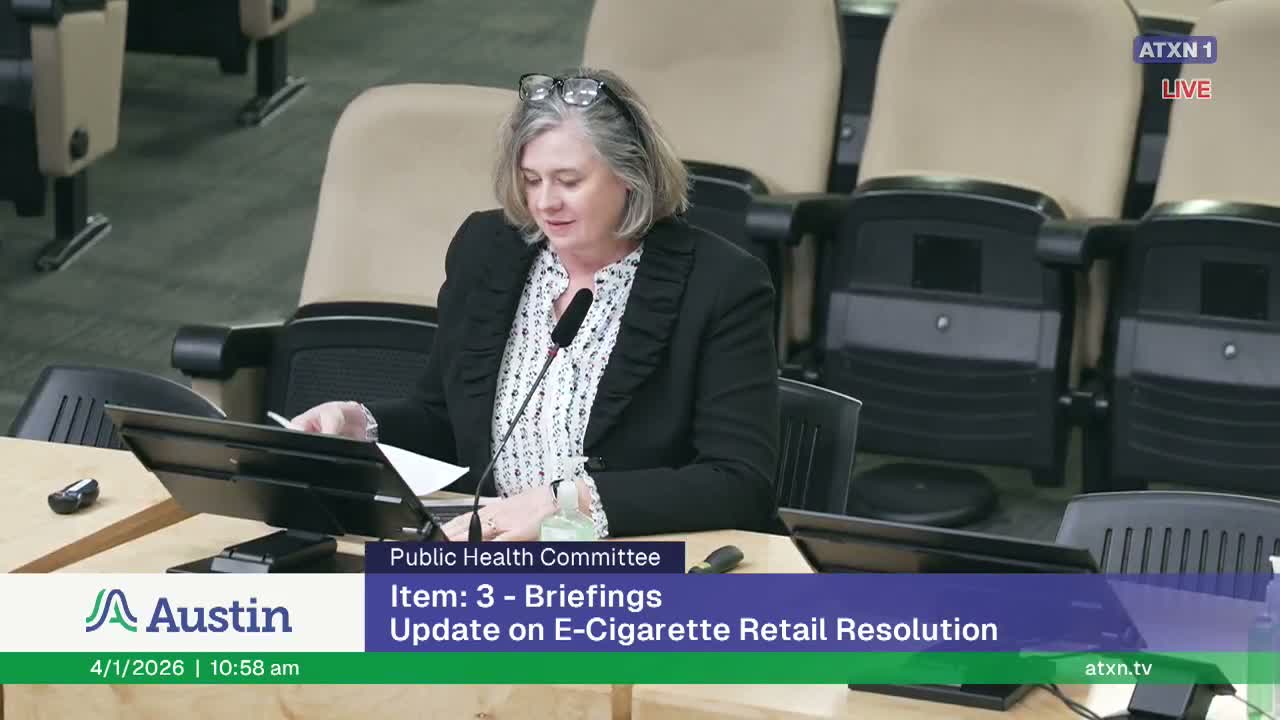
Austin Public Health staff told the Public Health Committee on April 1 that their research and stakeholder engagement found existing legal and enforcement constraints that make a local tobacco retail licensing approach infeasible in Texas, and recommended using a zoning ordinance to restrict new tobacco and e-cigarette retailers within 1,000 feet of schools and child-care centers.
Cassandra de Leon, deputy director of Austin Public Health, and Stephanie (staff lead on the resolution response) summarized the research: mapping identified more than 600 current retailers located within 1,000 feet of a school or daycare. The staff team evaluated three mechanisms for achieving the resolution's goal'local tobacco retail licensing, direct product regulation, and zoning'and concluded that state preemption prevents local licensing and that direct regulation would be difficult to enforce because no state entity (analogous to TABC for alcohol) performs permit checks for tobacco.
Staff recommendation: use zoning. The staff recommendation is to create a new land-use category that would block new tobacco or e-cigarette retailers from opening within 1,000 feet of public or private schools and childcare centers. Existing retailers would be grandfathered; staff proposed exemptions for full-service grocery or general retail stores larger than 12,000 square feet to avoid worsening food-access deserts. Staff also recommended updating city public-health code chapters to explicitly include synthetic nicotine products and nicotine analogs in the definition of tobacco products and e-cigarettes, aligning local code with the FDA's 2022 updated tobacco definition.
Stakeholder feedback: Schools and youth-serving organizations told staff that vape and e-cigarette use is disruptive to campuses and that limiting new retailers near schools could reduce youth exposure and marketing. Retailers raised concerns about business impacts and said a 1,000-foot buffer could limit expansion; vape stores did not participate in community forums, though staff completed targeted interviews with some store managers.
Enforcement and next steps: Staff said licensing at the local level is preempted by state law (handled by the Texas controller of public accounts), and that zoning provides a feasible enforcement pathway through planning and code processes. The proposal includes a memo to council and an anticipated hearing package to the planning commission and council; timing may be spring or fall depending on code package scheduling. Councilmembers asked staff to consult with city legal, the inspector general's office and state contacts about nuisance and enforcement options and whether hemp-derived products should be considered.
There was no committee vote on ordinance language during the briefing; staff said a memo is drafted and will be shared with council.