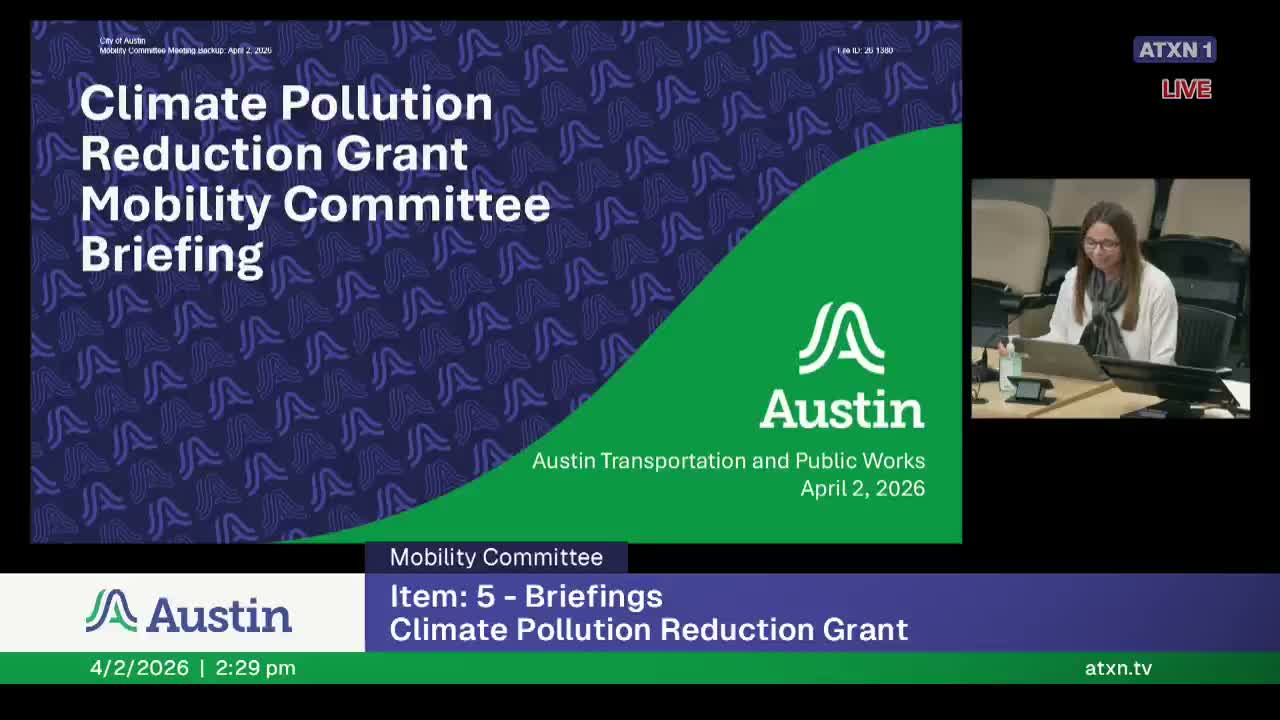
Austin outlines $47.8 million EPA grant to cut vehicle miles and boost transit and TDM
Loading...
Summary
City staff described a five‑year, $47.8 million Climate Pollution Reduction Grant that aims to reduce regional vehicle miles traveled by 39,000,000 miles through transit service improvements, new mobility hubs and demand‑management pilots including a transportation wallet and cash incentives.
Richard Mendoza introduced the committee to the city’s Climate Pollution Reduction Grant (CPRG) update on April 2, and Kristen Pipkin, managing engineer for special projects, said Austin received a $47,800,000 award from the Environmental Protection Agency covering 2025–2029.
Pipkin said CPRG’s core metric is vehicle miles traveled (VMT) and that the program’s five‑year target is a reduction of 39,000,000 VMT, which staff translated to the equivalent of roughly "820 people per day traveling by share, bike, bus, or scooter instead of driving alone." The work will be regional and involves partners including TxDOT, CAPCOG, CARTS, CapMetro and MoveAbility.
Staff described three coordinated measures: Measure 1 will improve transit services in partnership with CapMetro and CARTS and looks for adjustments that respond to I‑35 construction impacts; Measure 2 will build TDM infrastructure (40 mobility hubs over the grant life, 50 bike/ped counters and 50 air quality sensors, with 10 mobility hubs and 20 sensors planned for 2026); and Measure 3 will roll out travel‑options programs including a CTX GO regional mobile platform for trip planning and construction updates, a transportation wallet to provide benefits cards to up to 70 low‑income residents, and a "cash for commuters" pilot that pays employees who choose alternative modes.
Pipkin emphasized the outreach behind the program: roughly 1,700 community members participated in surveys, focus groups and intercepts regionally; about 72% of respondents rely on personal vehicles, and convenience, safety and travel time were the top factors influencing mode choice. Staff said pilots and marketing will be rolled out later in 2026 and that the CTX GO app is slated to be available to the public later this year.
Committee members asked about grant scope and whether the city could reallocate funds to other mobility infrastructure; Pipkin said the grant’s measures and eligible spending were established in the city’s application and must stay within the stated scope, and she noted the city pursues separate grants (for example, a TASA grant) for other complementary investments.
There was no committee action; staff will continue implementing pilots and coordinating with regional partners.