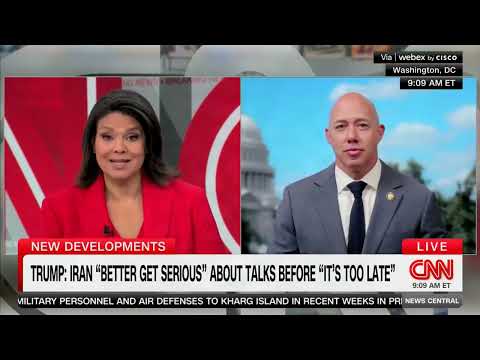
Rep. Brian Mast says Trump acted under Article II authority, calls boots on the ground in Iran unlikely
Loading...
Summary
Rep. Brian Mast, chairman of the House Committee on Foreign Affairs, defended President Trump’s strikes as an exercise of Article II war powers and said he did not view them as violating his 'America First' principles; he added that U.S. ground troops in Iran are 'highly unlikely' except in narrow scenarios.
Rep. Brian Mast, chairman of the House Committee on Foreign Affairs, said President Trump acted within presidential Article II authority when directing operations tied to Iran and defended those strikes as aimed at eliminating Iranian military targets that threaten the United States. "Absolutely not," Mast said when asked whether the president violated Mast's stated "America First" view on war.
Mast told the program the objectives of recent operations were "very clear from the beginning" and framed them as efforts to "eliminate every single Iranian military target that has reached out and touched America" and could do so in the future. He said those objectives, in his view, are a legitimate exercise of Article II powers but acknowledged there can be a point when the president should come to Congress.
The moderator presented a recorded clip of Rep. Nancy Mace, a Republican member of Congress and a member of the House Armed Services Committee, who said she was "adamantly opposed to boots on the ground" based on the information she had and questioned whether ground forces were necessary to "declare victory." Mast said he thinks it is "highly unlikely" that the United States will put boots on the ground in Iran and that Mace was not describing seeing a detailed plan for such deployments.
Mast allowed limited hypothetical scenarios in which U.S. forces might be required, citing, for example, operations related to Iranian fissile material that could demand specialized U.S. military tier‑1 or tier‑2 assets to "clean up" hazardous sites. He pointed to industrial areas in and around the Strait of Hormuz as examples of sites that are not population centers but that could be relevant in such a narrow context.
On regional dynamics, Mast said Gulf countries hit by Iranian rockets are increasingly coordinated and have realized the extent of the threat. He argued that those partners now seek to limit Iran's military reach and would not accept a return to Iran's prior posture.
The moderator closed the segment by thanking Mast for appearing. No congressional action, vote, or formal authorization was announced during the interview.