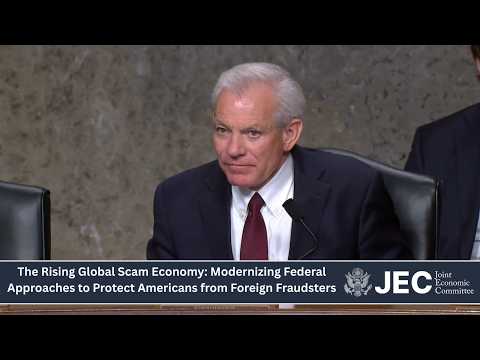
Chair presses witnesses on tech and policy to stop scams that drain seniors' accounts
Loading...
Summary
At a Joint Economic Committee hearing, the chair pressed witnesses on technological and policy solutions to prevent scammers from moving money out of older Americans' accounts, focusing on blocking scam communications, stopping suspicious payments at the rails, industry cooperation, and family-account safeguards.
The chair of the Joint Economic Committee pressed a panel of witnesses on how to prevent scammers from permanently taking money from older Americans, asking whether the government and private industry can build systems "so the money never leaves the individual's account." The hearing centered on two complementary strategies: stopping scam contact (communication vector) and stopping or reversing suspicious transfers (payment vector).
"How do we build a model, a technology, a policy so the money never leaves the individual's account," the chair asked, framing the session around preventing irrevocable transfers to fraudsters. Panelists acknowledged the limits of education alone and urged a blend of consumer outreach, industry technology, and payment-rail controls.
A witness with direct family experience said education remains a core pillar but is uneven across agencies. "A lot of what we have seen is various agencies in the government with their own mandates, of course, doing education, but not doing it comprehensively and filling in the gaps," the witness said, arguing for coordinated public education alongside technical measures.
Panelists described a two-track technical approach. A law enforcement official recommended preventing initial contact by detecting and blocking scam calls, texts, emails and social-media messages; at the same time, payment systems'from traditional banks to crypto exchanges and ATMs'should be prepared to halt or flag suspicious transfers. "Once a victim is compromised and wants to send their funds, those payment systems have to be ready to deal with that and prevent that payment from going elsewhere," the official said.
Witnesses urged private-industry cooperation: providers could send customer warnings when they detect suspicious behavior, and platforms could adopt more aggressive blocking. One panelist cited international examples, saying Singapore offers government apps to help consumers verify scam sites and wallets.
Committee members and witnesses discussed specific, practical safeguards. The chair described a family-control arrangement in which transfers above a threshold (an example cited during the hearing: $5,000) require contact with a designated family member or co-authorization at the financial institution. Panelists noted some banks already offer such services but that uptake depends on families initiating those protections.
Representatives also pointed to telecommunications and verification frameworks. A commission representative recommended stronger verification and anti-spoofing measures such as the STIR/SHAKEN framework, which is designed to verify caller ID information, and urged deeper cooperation between carriers, platforms and financial intermediaries to detect and stop fraud moving into cryptocurrency and other payment rails.
Panelists highlighted prior federal efforts intended to spur industry solutions: the FTC'and other agencies have used prize challenges (under statutes such as the America COMPETES Act) to encourage technology that detects voice cloning and other advanced spoofing techniques. One panelist encouraged committee members to review reports and working-group findings; the chair asked witnesses to share their materials.
The hearing did not produce formal votes or immediate policy changes; rather, it focused on aligning government and private-sector tools (education, call and message blocking, payment-rail controls and verification frameworks) to reduce the number of successful scams and to increase the likelihood of stopping transfers before funds leave victims' accounts.
The committee signaled follow-up: witnesses agreed to share reports and working-group findings, and the chair moved to the next witness.