Get Full Government Meeting Transcripts, Videos, & Alerts Forever!
Get email alerts on the Session Roundup topic
No spam. Unsubscribe anytime.
West Virginia Senate passes slate of bills including Blue Envelope program and Vape Safety Act
Summary
During the March 10, 2026 floor session the West Virginia Senate passed a wide array of bills and resolutions — many by unanimous margins — including recognition of Hunger Free West Virginia Day, the Blue Envelope program for drivers with communication-affecting conditions, the Vape Safety Act, and numerous statutory and administrative measures; a votes-at-a-glance list follows.
The West Virginia Senate completed a broad floor agenda on March 10, 2026, adopting resolutions, advancing committee reports, and passing multiple House and Senate bills on unanimous or near‑unanimous votes.
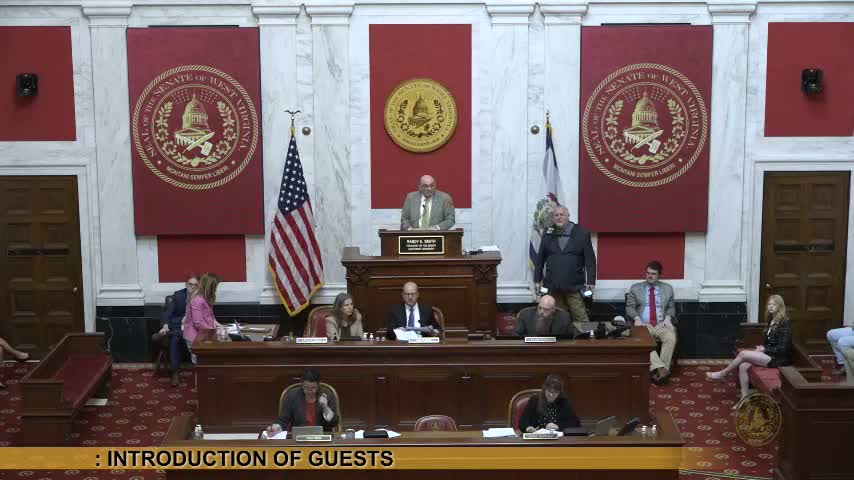
Members began by recognizing guests and nonprofit organizations, including Hunger Free West Virginia and the Mountaineer Food Bank. Later in the session the clerk reported numerous House amendments and committee substitutes; the Senate concurred and passed many of those measures by machine vote.
Votes at a glance (selected items recorded on the floor record): - Senate concurred in House amendments to Senate Bill 467 (Purple Heart parking enforcement) and the bill passed (machine vote 34–0). (SEG 267–306) - Senate Bill 712 (cattle guards on certain public roads) — concurrence and passage (34–0). (SEG 312–340) - Senate Bill 781 (supplemental appropriation for civil contingent fund) — passage and made effective from passage (34–0). (SEG 344–392) - Senate Bill 844 (Department of Human Services supplemental) — passed (34–0). (SEG 882–921) — (See separate article.) - Engrossed House Bill 44‑53 (Blue Envelope program) — passed (34–0). The measure directs the West Virginia State Police to develop envelopes for drivers diagnosed with autism spectrum disorder, dementia, or intellectual and developmental disabilities to assist officer communication and to hold driver documentation; the State Police would be prohibited from collecting or storing identifying information except as necessary to distribute the envelope. (SEG 963–1001) - Engrossed House Bill 40‑89 (Preservation of Hair During Chemotherapy, "Jessica Huffman Bill") — passed (33 yays, 1 nay, 1 absent); requires coverage, beginning Jan. 1, 2027, for scalp cooling systems used with chemotherapy in health plans issued or renewed after that date. (SEG 1011–1033) - Engrossed committee substitute for House Bill 54‑37 (Vape Safety Act) — committee strike‑and‑insert adopted; bill passed (34–0). The bill regulates vape/smoke shops, licensing, advertising, labeling and establishes criminal and administrative sanctions. (SEG 1672–1755) - Engrossed House Bill 46‑38 (registering organ donors at voter registration) — passed (30 ayes, 4 nays). (SEG 1319–1337)
Other bills advanced, read, or amended on second reading included measures on sanitation board training, workforce reporting, juvenile jurisdiction on military installations, reforms to boards and commissions, and numerous supplemental appropriation bills across state agencies. Where roll-call tallies were recorded on the floor, they are noted above using the clerk’s machine totals.
What it means: the session record shows broad, largely bipartisan support for an extensive package of bills ranging from programmatic and regulatory changes to substantial supplemental appropriations. Several bills were advanced with committee amendments or strike‑and‑insert amendments and passed by recorded votes.
Next steps: for bills passed by the Senate, the clerk was directed to communicate action to the House; several measures were also moved to take effect from passage by recorded votes.