Get Full Government Meeting Transcripts, Videos, & Alerts Forever!
Get email alerts on the Education Advanced Placement topic
No spam. Unsubscribe anytime.
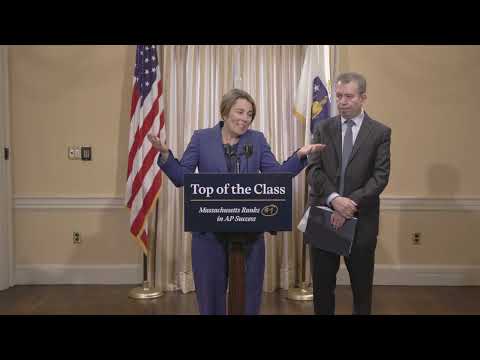
Governor: Massachusetts tops nation in AP participation and pass rates, highest ever recorded
Summary
The governor announced Massachusetts ranks first nationally for Advanced Placement (AP) exam participation and pass rates—recording the highest state level ever—highlighting state subsidies for low‑income students, gains among Black and Latino students, and plans to expand early college to 100,000 students.
The governor announced that Massachusetts is number one in the nation for Advanced Placement participation and passing rates, saying the state’s performance is the highest ever recorded by any state. "We're number 1 in the country on advanced placement exams," the governor said, framing the result as evidence of strong teaching and student support.
Department of Elementary and Secondary Education Commissioner Pedro Martinez reiterated the finding and provided participation details, saying nearly 48% of the class of 2025 had exposure to Advanced Placement coursework and that more than 86% of the state’s high schools offer AP classes. "At this scale...it is just very impressive," Martinez said, noting participation increases over the last decade and larger gains for Black and Latino students.
The administration highlighted specific efforts that officials say helped drive results: subsidized AP exam fees for low‑income students, which the governor said enabled roughly 50,000 low‑income students to take nearly 91,000 exams; expanded early college programs; apprenticeship and career pathways; and investments in childcare, universal pre‑K in gateway cities, a statewide literacy initiative and a high‑dose tutoring program aimed at overcoming pandemic learning loss.
Officials tied the AP achievement to broader goals. The governor described AP success as saving families money through earned college credit and signaling to employers that Massachusetts graduates are well prepared. Martinez said combining AP, early college and career‑technical education creates a stronger pathway for students, and he pledged the administration would continue expanding early college access toward a stated target of enrolling 100,000 students.
Reporters pressed officials on persistent achievement gaps. Martinez acknowledged gaps remain but said rising participation—particularly among historically underserved groups—and a mix of early education and targeted K–12 investments should help narrow disparities over time. The governor emphasized continuing investments from birth through K–12 and said the state is working to close racial disparities in outcomes.
The commissioner and governor also addressed questions about the College Board’s methodology and any recent recalibrations. Martinez said recalibrations apply to all states and that the administration has confidence in the College Board’s review of the statistics; he added the state would investigate any apparent discrepancies while standing by the reported results.
The administration framed the announcement as both an academic milestone and part of a larger strategy to expand access and opportunity for Massachusetts students.