Lifetime Citizen Portal Access — AI Briefings, Alerts & Unlimited Follows
OHA trustees activate about $3.96 million in disaster aid for communities hit by March Kona low
Loading...
Summary
The Office of Hawaiian Affairs Board of Trustees unanimously approved redeploying approximately $3.96 million in existing funds on March 25, 2026, to provide immediate aid and home-repair grants for Native Hawaiian households affected by the March Kona low floods. The package reallocates EOLA funds, provides direct disaster grants and Malama Honua home-repair awards, and delegates implementation authority to OHA administration.
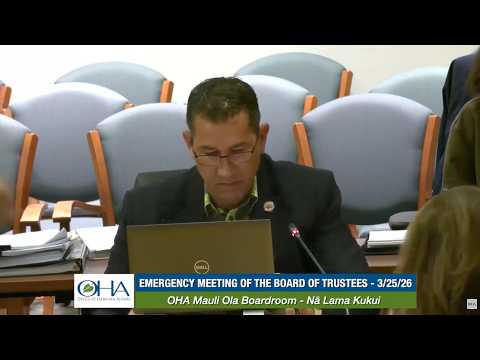
The Office of Hawaiian Affairs Board of Trustees on March 25, 2026, voted unanimously to activate roughly $3.96 million in disaster aid and OHA’s disaster-aid framework to help Native Hawaiian households affected by the March Kona low flooding.
Chair Kahele read into the record a motion that would redeploy up to $2.9 million in remaining encumbered EOLA (emergency aid) funds — including a $100,000 set-aside for community resource hubs and $300,000 reserved as bridge support for furloughed Department of Homeland Security (DHS) workers — authorize $410,407 in FY26 disaster-grant funds for direct OHA disbursements, and use $250,000 from the Malama Honua home-repair program to provide $10,000–$20,000 repairs to affected households. The motion also delegated to the OHA administrator authority to award the grants and to set program parameters.
Interim OHA Administrator Summer Silva told trustees the three-part approach would pair rapid, redeployed EOLA assistance with an in-house disaster-aid grant path and targeted home repairs through Malama Honua. "This approach builds on what we know works," Silva said, arguing the mix of redeployed and internal funds allows OHA to act quickly while preserving accountability.
Hawaii Emergency Management Administrator James Barros briefed the board on the storm’s scope and response: the Kona low produced intense, localized rainfall and runoff that overwhelmed infrastructure in multiple islands and required immediate damage assessments with FEMA. Barros said dam safety teams confirmed Wahiawa Reservoir operated as designed and that some early messaging had created confusion. "A warning means it’s happening. A watch is when the National Weather Service says, ‘potentially you might have flash flooding,’" Barros said, calling for clearer public messaging going forward.
Kuhio Luis, CEO of the Hawaiian Council, reported preliminary survey data collected by his organization and partners, noting early samples show widespread water damage and that a large share of respondents lacked flood insurance. Luis said his organization had raised and matched donations and had already used some funds to directly support community hubs, and he urged OHA to work with established local partners to distribute aid rapidly.
Trustees pressed administration and outside presenters on implementation details, data cadence, neighbor-island allocation, and eligibility verification. Administration said the EOLA redeployment would prioritize verified Native Hawaiian households in heavily impacted areas statewide and that OHA planned a two-week update cadence tied to an evolving dashboard and field assessments. Silva and staff also recommended retaining a $100,000 immediate-allocation buffer for nonprofits and community distribution hubs to provide essentials such as water and hygiene supplies while the larger, data-driven distribution rolls out.
The board’s approved motion instructs administration to proceed with contract amendments (including an extension where needed) and to provide regular sit-rep updates. The roll-call vote recorded eight 'aye' votes and the chair announced the motion carried.
During public comment, a Waianae community member urged review of siren activation protocols and improvements in emergency communications after prolonged outages and reported difficulty contacting loved ones during the floods. Trustees asked administration to prioritize neighbor-island outreach and to provide transparent reporting on disbursements and program timelines.
Next steps: administration will finalize contract amendments with Hawaiian Council where applicable, stand up the expanded dashboard and reporting cadence, begin targeted outreach to identified high-impact communities statewide, and move to distribute immediate supports (gift cards and hub grants) while completing HRP (Hawaiian Registry Program) verification and grant adjudication processes.