Get Full Government Meeting Transcripts, Videos, & Alerts Forever!
Get email alerts on the Procurement topic
No spam. Unsubscribe anytime.
McAllen ISD trustees review procurement scoring matrix, RFQ approach ahead of potential $335M bond
Summary
At a March 11 board workshop, McAllen ISD staff walked trustees through a purchasing scoring matrix and procurement options for architects, engineers and construction work tied to a possible $335 million bond; trustees pressed for clearer rubrics on reference letters, joint-venture scoring and on-time/on-budget metrics.
McAllen Independent School District staff on March 11 presented trustees with a proposed purchasing scoring matrix and explained how the district plans to select architects, engineers and construction contractors for routine work and for projects tied to a possible $335,000,000 bond.
Laura Williams, the district's director of purchasing services, said the matrix is intended to provide a consistent way to evaluate proposals by assigning points across criteria such as price, qualifications, experience and ability to meet district specifications. "Those costs, if they exceed $50,000, then we will need to hire an architect and engineer to help us with that process," Williams said, describing statutory thresholds the district uses for professional services and citing examples for new buildings and electrical or mechanical work.
Why it matters: Trustees will use the matrix and procurement approach to guide dozens of expected projects over multiple years if voters approve a bond. The board's allocation of points (price, references, resumes, safety and quality) will shape which firms win work and how local versus nonlocal firms compete.
Trustees debated several specific scoring choices. Williams said the district currently allocates 100 points to an evaluation and typically gives 60 points to price in competitive sealed proposals; the remaining points are distributed among experience/reputation, personnel, safety records and other factors. "We have a maximum point value of a 100 points, obviously, with the price being the best value," Williams said, noting price receives the largest share of points.
Several trustees questioned whether certain items were over- or underweighted. Trustee Haddad asked why McAllen assigns points for joint ventures and reference letters, saying the current structure could give small firms an outsized advantage when partnering with larger contractors. "What's the benefit of giving them extra points?" Haddad asked. Williams acknowledged joint ventures were part of an initial pass and said the district can change that item to a yes/no question or reduce its weight.
Trustees also pressed for objective safeguards on reference letters and resumes. Williams said the district uses a standardized reference form with point values and posts the rubric and rationales in the board packet and on the purchasing website so vendors see how submissions are scored. On safety, staff said the district reviews standardized OSHA logs for a specified timeframe (for example, 2020—6 to 2025) rather than relying only on self-created safety manuals.
On contracting approach for the bond, staff recommended soliciting RFQs and creating a pool of architects and engineers. Williams said for the larger bond work "one firm would not be able to handle that workload," and that a project manager should be hired to prioritize and oversee multi-year work. Trustees discussed whether one project manager is sufficient for the scale of the bond and whether manager fees (staff referenced a prior RFQ where project manager fees were about 4% of the bond) could be tied to performance metrics.
Staff outlined seven procurement delivery methods the district may use depending on project scope: competitive bidding, competitive sealed proposals (the district's primary method), construction manager agent, construction manager at risk (with guaranteed maximum price), design-build, job order contracts and interlocal contracts. Williams cited Texas Government Code chapter 2269 and the Professional Services Procurement Act as controlling references for method selection and professional-services procurement.
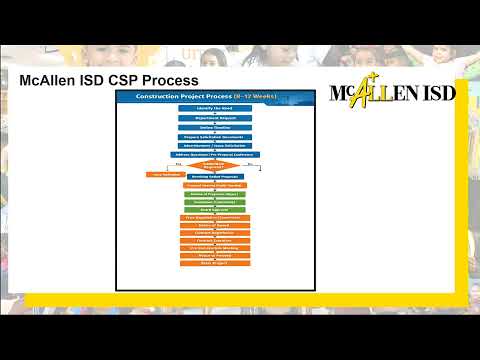
The presentation concluded with a walk-through of the solicitation timeline and evaluation process: a typical 8—12-week window from need identification to project start, public advertisement requirements, a posted rubric for transparency, an evaluation committee composed of purchasing staff and applicable department staff, consensus scoring, negotiation with the top-ranked vendor, notice of award and final contract negotiation with in-house legal before issuing a notice to proceed.
The board did not take action on procurement policy changes during the workshop. A trustee moved to adjourn at the end of the session; the motion passed 6—6.
Next steps: Staff will revise the scoring matrix to address trustees' concerns about joint-venture points, reference-letter weight and quality/safety metrics and return a draft for board review.