Get Full Government Meeting Transcripts, Videos, & Alerts Forever!
Get email alerts on the School Budgeting topic
No spam. Unsubscribe anytime.
Superintendent explains how 'support units' drive West Jefferson funding and warns against unfunded hiring
Summary
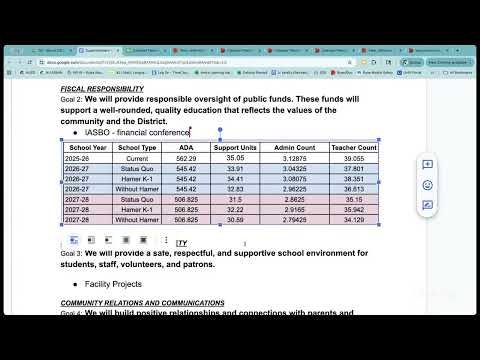
The district superintendent told trustees that West Jefferson’s funding is set by a support-unit multiplier tied to average daily attendance (stated as 35.05), outlined how that converts to admin and teacher allocations, and cautioned that hiring beyond funded positions risks exhausting the district’s budget. No vote was taken.
The district superintendent described how West Jefferson’s school funding is determined and cautioned trustees against staffing beyond what the funding formula supports. He said the district’s current support unit is "35.05," which is based on average daily attendance rather than total enrollment, and that the district qualifies for 3.1 administrative units that translate to roughly 39.55 teacher units.
"We have to be transparent," the superintendent said, adding that the district must "live within our budget" and prioritize what can be funded. He explained that support units are a multiplier that "drives the money that comes into the district," and that funding is calculated from average daily attendance (the number of days students are in seats), not by assigning an amount for each individual staff member.
The superintendent noted enrollment and attendance figures while acknowledging some uncertainty in mid-discussion: he said the district had "more than 562" students, later suggested the number might be in the mid-580s, and referred to a reported figure of 575 as the working number. He also said West Jefferson’s attendance rates are about "93–95%," which affects the average daily attendance figure used in the funding formula.
Pointing to the district’s experience before his tenure, the superintendent said the district had been "out of balance" but has been bringing staffing in line with funding over the last five to six years. "The number 1 thing not to do as a superintendent to run your district into the ground is hire more teachers than what you get paid for," he said, framing the discussion as a caution about fiscal sustainability rather than a proposal for immediate cuts.
On projected enrollment, he said next year’s numbers are expected to be roughly 17–22 students fewer than the prior year and that this decline, combined with attendance-driven funding, would reduce revenue. He described the agenda item as a set of discussion options, not decisions, and did not present a formal motion or request a vote during the session.
Trustees did not take formal action on the item during the recorded discussion; the superintendent framed the items as options to ensure the district remains fiscally responsible while supporting student education.
Next steps: the discussion remained an informational briefing; no formal direction or vote on staffing or budget changes was recorded during this item.