Get Full Government Meeting Transcripts, Videos, & Alerts Forever!
Get email alerts on the Open Meetings topic
No spam. Unsubscribe anytime.
Germantown village attorney gives training on open meetings, quorums and closed sessions
Summary
Brian Sadak, Germantown village attorney, trained local board and commission members on Wisconsin open meetings law—covering notice, quorum math, walking/negative quorums, electronic communications, and the limited, enumerated bases for closed sessions. No formal action was taken.
Brian Sadak, the village attorney for Germantown, led an evening training for local board and commission members on Wisconsin’s open meetings law, emphasizing notice requirements, quorum rules and when closed sessions are permitted.
The session focused on everyday compliance risks and court tests that shape enforcement. “The legislature says … representative government really relies on an informed electorate,” Sadak said, arguing courts favor interpretations that maximize public access. He told attendees that failing to post required notice most commonly renders actions void rather than triggering criminal enforcement, though individual members can face inquiries from the district attorney.
Sadak reviewed what constitutes a governmental “body” and explained that gatherings become meetings when a quorum convenes to exercise authority. He illustrated how courts examine whether the gathering had the purpose of conducting governmental business and whether enough members were present to determine the body’s course of action. Using a hypothetical about trustees, he warned that successive one‑on‑one conversations can coalesce into a “walking quorum” if they demonstrate tacit or express agreement to act together.
On quorum calculations, Sadak noted two approaches—basing counts on full membership or on the members eligible to vote—and recommended a conservative approach to minimize legal risk. He offered a practical rule of thumb for village boards: where a seven‑member body exists, a quorum typically equals four (50% rounded up), and members should be cautious about informal contacts that could be construed as coordinating votes.
Sadak also cautioned about electronic communications: emails and texts can look like deliberations and create walking‑quorum risks if participants circulate others’ positions. “Remember, don’t reply all to that message,” he said, explaining that limiting back‑and‑forth outside publicly noticed meetings helps avoid problems.
On closed sessions, Sadak summarized statutory constraints and procedures: bodies must start in open session, publicly announce the legal basis for closing, and record a roll‑call vote. He identified common permissible grounds attendees see—personnel matters, conferring with legal counsel about litigation, and negotiating for property or funds—and stressed discussion must be limited to the stated purpose. He said some municipalities now include short memos in meeting packets explaining the closed session basis to strengthen the public record.
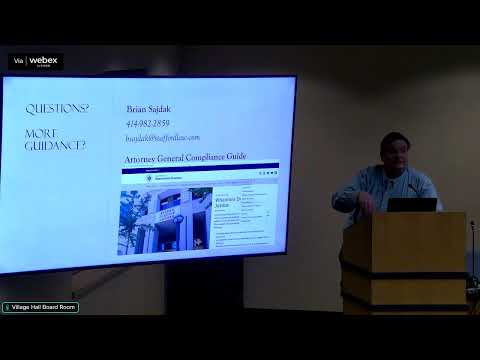
Sadak closed by offering follow‑up guidance and pointing attendees to state compliance resources. The session was instructional; no motions or votes were taken.