Get Full Government Meeting Transcripts, Videos, & Alerts Forever!
Get email alerts on the Comprehensive Plan topic
No spam. Unsubscribe anytime.
Muskego council recommends removing “eco‑industrial” language from draft 2035 plan after residents’ complaints
Summary
After a packed public hearing, Muskego aldermen voted to ask the Planning Commission to remove an "eco‑industrial" paragraph and its map cross‑hatching from the draft 2035 comprehensive plan, responding to neighbors’ concerns about potential hazardous uses and past concrete‑crushing activity.
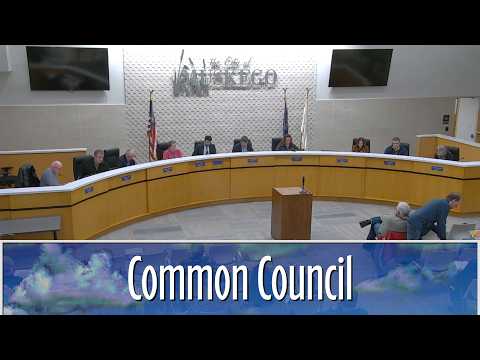
MUSKEGO, Wis. — Facing concerns from multiple neighborhood associations about possible hazardous uses, the Muskego Common Council on March 10 voted to recommend that the Planning Commission remove the "eco‑industrial" paragraph and map cross‑hatchings from the draft 2035 comprehensive plan.
At a public hearing that filled the council chamber, residents from subdivisions near the city’s southeast landfill and quarry told council members that language in the draft describing "producers of composite and recycled materials" could be read to allow operations that produce dust, fumes or other hazards. Jim Galeszewski, president of the Glen and Muskegon Lakes Condo Association, urged removal of what he called "six words" that worry homeowners: "If you were to take out those 6 words, I'd be a happy guy," he told the council.
City planning staffer Adam said the eco‑industrial language is carryover text from earlier plans (first adopted in 2009 and retained in the 2020 plan) and does not change zoning rights. "Zoning will always prevail," Adam told the council, explaining that the designation is a nonbinding "desired development area" meant to encourage green technologies and is separate from specific zoning districts and their permitted uses.
Still, multiple speakers cited a recent incident in which a portable crusher operated near homes and produced dust that raised health concerns; residents asked for clearer definitions, stronger local notice and annual recertification for businesses approved in sensitive areas. Former Mayor Cathy Chevarotti suggested codifying broader notice requirements than the statute’s 100‑foot minimum.
The council considered options presented by staff, including simply striking the paragraph or removing the map markings for the two nodes labeled "eco‑industrial." Alderman Wolf moved and Alderman Bryce seconded a recommendation that staff forward to the Planning Commission a red‑lined version removing the eco‑industrial text and map designations. The motion passed and the amendment will be considered at the Planning Commission meeting the following evening and return to council for final action March 24.
Adam told the council the city would provide a marked‑up version showing the deleted text and map changes in the packet before the March 24 final vote. He reiterated that, regardless of the comp plan wording, any business must still follow the city’s zoning code and obtain required DNR/EPA permits when applicable.
The council’s action was procedural: the recommendation sends a proposed removal to the Planning Commission rather than adopting a final plan at that meeting. Residents and council members were told they may submit additional input to Adam or attend the Planning Commission meeting.
What’s next: the Planning Commission will consider the recommended edits and a red‑lined plan package at its next meeting; the council scheduled final adoption of the comprehensive plan for March 24.