Get Full Government Meeting Transcripts, Videos, & Alerts Forever!
Get email alerts on the Street Trees topic
No spam. Unsubscribe anytime.
Oregon City commission seeks tougher penalties, tiered fines for unauthorized street-tree removal
Summary
City staff recommended options ranging from raising the $300 civil infraction to a tiered penalty tied to tree size and zone; commissioners favored stronger deterrents and asked staff to return with code and fee language. No vote; staff to consult municipal court and bring back options.
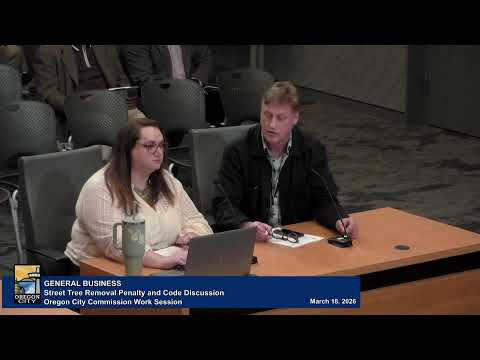
Oregon City commissioners on March 18 debated whether to raise the municipal civil infraction for unauthorized street-tree removal and to adopt a tiered penalty structure that would impose larger fines for bigger trees and enhanced charges in downtown corridors.
City Manager Conkle opened the discussion by saying the issue has been a commission priority after multiple recent unauthorized removals downtown and at Waterbury Park and that staff prepared comparisons with Lake Oswego and Milwaukee. Staff told commissioners the current civil infraction for many code violations is $300 (a figure last updated in 1994) and that a CPI-based update would place an equivalent fine nearer $725. Staff presented two models: a higher base civil infraction and a separate tree penalty tied to tree size or an enhancement fee applied in high-priority zones.
The commission’s comments ranged from support for a citywide deterrent to proposals that would protect Main Street and the 7th/Molalla corridor with higher multipliers. Mayor Denise McGrath said the city should protect its canopy and warned that many removals “seem like a lot of the tree removals have been premeditated.” Several commissioners pressed for penalties that make removal “painful” enough that owners reconsider unauthorized cutting and emphasized that mitigation — replacing trees where feasible — must still be required.
Staff and a local arborist (Pete) explained enforcement mechanics and courtroom considerations. Staff said municipal court Judge Lindgren can reduce a codified civil infraction but cannot raise a codified maximum; staff will clarify whether language authorizing judicial adjustment can be included in a penalty code or fee resolution. Pete said stump measurements and photographs typically allow staff to estimate diameter for enforcement and that certified arborist testimony may be needed for court-admissible determinations.
Commissioners debated formulas for fines, including per-inch penalties used elsewhere, flat tier caps for diameter-at-breast-height categories and zone multipliers for downtown or mixed-use corridors. One proposal discussed was using the commission’s existing mitigation tiers for replacement (less than 6 inches; 6–12; 13–18; up to 31 inches and over) and adding an enhancement penalty for very large trees. Commissioners also discussed the fee-in-lieu option, which staff described as a last resort after attempts to replace the tree at or near the original location or in a city park; staff noted the in-lieu amount currently used when adopted was about $500.
No ordinance or resolution was adopted at the meeting. After discussion, the commission directed staff to return with draft code or fee language that: (1) preserves a clear, objective tiering approach for fines that ties to mitigation categories; (2) identifies a top-end fine and a workable per-inch or tiered schedule; (3) defines which zones would carry enhanced penalties (with suggested multipliers for downtown corridors); and (4) clarifies whether judicial discretion should be codified. Staff also will confirm how the municipal court currently handles tree-penalty reductions and liens.
The work session ended with the commission asking staff to bring back the recommended language and administrative options for how frequently the fee would be reviewed or adjusted. The commission did not take a formal vote and adjourned the session.