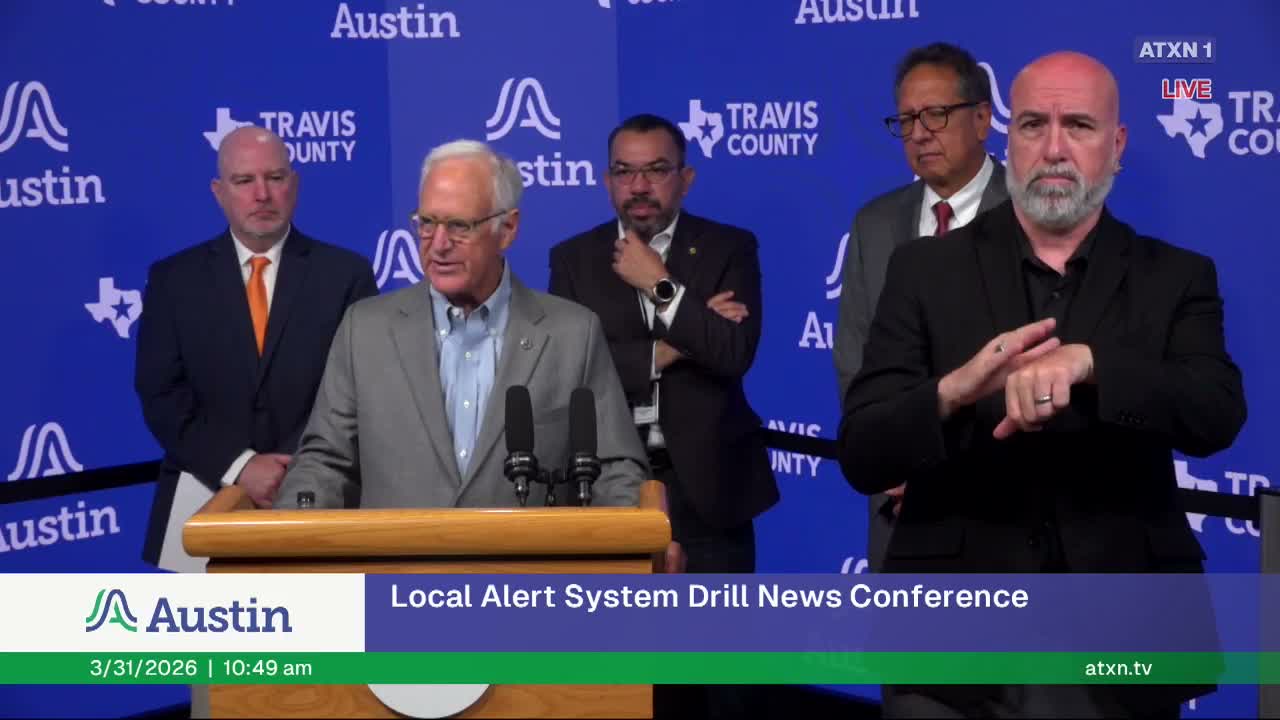
Mayor Watson, city and county urge Austinites to sign up ahead of statewide alert drill April 2
Loading...
Summary
City and county emergency leaders said Austin will join a statewide test of emergency-alert systems on Thursday, April 2, and urged residents to register for Warn Central Texas and check device settings because wireless alerts may not reach everyone without proper settings.
Mayor Watson announced that the City of Austin and Travis County will participate in a statewide test of emergency alerting systems on Thursday, April 2, and urged residents to sign up for Warn Central Texas and check mobile‑device settings so they receive life‑saving messages.
The test, described by Watson as a “first of its kind statewide test,” will exercise multiple alert channels, officials said. "This is literally a matter of life and death," Watson said, urging residents to register at WarnCentralTexas.org so they can receive follow‑up information after a wireless life‑safety alert.
Jim Reddick, the city's director of Austin Emergency Management, said the exercise will use both IPAWS — the Integrated Public Alert and Warning System — and the wireless emergency alert mechanism familiar from AMBER and weather warnings. "We do test this system on a monthly basis, but there's a different feeling when you know the message is gonna go out to the entire community," Reddick said, and he explained that Warn Central Texas is subscription‑based while wireless emergency alerts can be broadcast to devices in a geographic area without subscription.
Reddick also warned about overlapping messages and alert fatigue: he said Texas is currently "number 1 in the nation for folks who opt out of alerts," and that officials are working with messaging experts to hone wording and thresholds so that alerts remain trusted and effective.
Hector Nieto of the Travis County Office of Emergency Management said the county coordinated with 23 smaller cities and municipalities inside Travis County to ensure coverage, and he cautioned that people traveling across jurisdictions may receive multiple messages depending on timing and location. "You may receive multiple messages depending on where you're at," Nieto said.
Officials advised steps residents can take now: sign up at WarnCentralTexas.org for text and email follow‑ups, check phone settings so wireless emergency alerts are enabled, and consider an inexpensive NOAA/weather radio as a non‑cellular backup for area‑encoded messages. Reddick described Warn Central Texas as better able to provide follow‑up details such as evacuation or assembly locations, while the wireless emergency alert will be used for immediate, time‑critical instructions.
Reporters asked about timing; officials said the test will occur during a mid‑morning window that may vary by jurisdiction, roughly between 10 a.m. and 11:30 a.m. depending on local scheduling. Staffers will be available to answer questions about missed or duplicated messages after the test, officials said.
The briefing closed with Watson thanking the public‑information officers and media partners and reiterating the request that residents register for alerts and rely on official channels rather than social networks during emergencies.