Orinda Planning Commission recommends council adopt citywide objective design standards
Loading...
Summary
The Orinda Planning Commission voted unanimously to recommend that the City Council adopt citywide objective design standards (ODS) and an ordinance amending Title 17, with staff-directed clarifying edits and an added introductory 'how‑to' describing the ministerial streamlining path under state housing law.
The Orinda Planning Commission voted unanimously on March 24 to recommend that the City Council adopt citywide objective design standards and an ordinance amending Title 17 of the municipal code, with staff-directed clarifying edits and an added introductory "how‑to" explaining when projects may use the state‑streamlined ministerial path.
City planning staff and a consultant presented the February 2026 draft ODS as a tool to make eligible residential projects ministerial and more predictable under recent state housing laws. Christine Thompson, a city planning staff member, told the commission the standards "are an important piece" that apply across residential and open‑space districts and help align local review with state streamlining rules.
Why it matters: The ODS are intended to provide objective, measurable design criteria that, when met, allow eligible housing projects to follow a ministerial (staff‑level) approval track rather than discretionary review. Thompson said the draft ties design guidance to state provisions such as SB 9 and SB 1123 and includes clarifying definitions and references to state guidance to help applicants and staff navigate changing law.
Staff presentation and key provisions: Thompson described the document's three main parts—site design, building design and subdivision standards—plus definitions and measurement methods. She highlighted new language addressing hillside context and natural‑feature retention, a standardized plant palette (scientific names first), a universal color reference for exterior materials, measures to shield parking from public view, and coordination with the fire district and state fire marshal resources. "Objective standards are the only basis upon which a local agency may deny the approval of a residential project," Thompson said, stressing the standards' role in a ministerial approval path.
Consultant input: Tony Perez of Opticos Design said the draft emphasizes building components and form‑based choices tailored to Orinda's smaller building scale, noting many cities are still refining how standards function in practice. "We're trying to look at a building in its site as a menu of components," Perez said, explaining why the document is detailed.
Questions and clarifications: Commissioners pressed staff on practical matters—how eligibility for the ministerial path will be determined, when projects would be considered at staff level versus returning to the commission, and whether lessons from other cities informed the draft. Thompson said eligibility remains driven by state criteria (for example, historic sites are generally excluded) and that applicants can choose whether to use the ODS ministerial path or the standard discretionary path.
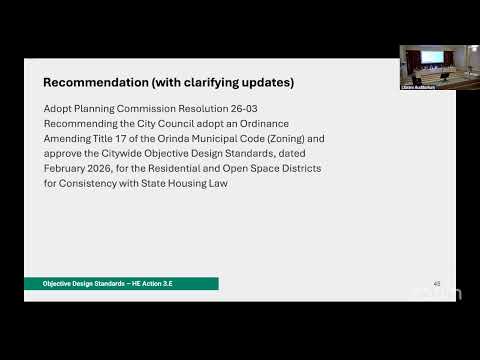
Motion and vote: After public comment opened and closed with no speakers, a commissioner moved to adopt Planning Commission Resolution 26‑03 recommending that the City Council adopt an ordinance amending Title 17 and approve the citywide ODS dated February 2026, with the clarifying updates presented by staff and an added introductory "how‑to" section explaining when the ministerial path applies. The motion was seconded and passed by unanimous roll‑call vote; the chair noted the motion carried.
What happens next: The Planning Commission's action sends Resolution 26‑03 to the City Council for consideration. Staff will incorporate the clarifying edits noted at the hearing and maintain a reference on the city's website to summarize applicable state laws and effective dates.
Adjournment and other business: The planning director reported the annual progress report had been submitted to the state; the commission then adjourned.