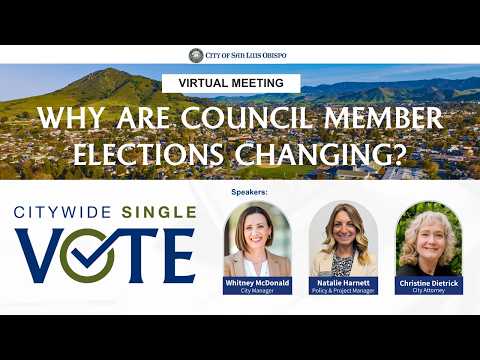
San Luis Obispo officials outline switch to citywide single-vote system, start voter-education campaign
Loading...
Summary
City staff said the council adopted a citywide single-vote system for council-member elections, effective with the Nov. 3, 2026 election, to address California Voting Rights Act concerns and avoid costly litigation; officials detailed outreach, Spanish-language materials, and a post-2026 evaluation plan.
San Luis Obispo city officials announced a change to how voters will cast ballots for council members beginning with the Nov. 3, 2026, election, saying the city has adopted a citywide single-vote system in response to legal concerns and demographic analysis and will roll out an education campaign to make sure ballots are filled out correctly.
"We want to explain what is changing, what is staying the same, how we got here, and what it means for you all as voters," Whitney McDonald, San Luis Obispo city manager, said as she opened the informational session. City staff emphasized the practical rule voters must remember: select one council-member candidate; the two candidates with the most votes will win the two open seats.
City Attorney Christine Dietrich told attendees the change grew out of two demand letters under the California Voting Rights Act (CVRA), the state law intended to address vote dilution for racial or language minority groups. Dietrich said the city retained legal and demographic experts after a 2023 demand letter and concluded the Latine community in San Luis Obispo is geographically dispersed and would not reliably form a majority within a single district. That finding led the council to reject district elections and instead adopt the citywide single-vote option as a compromise to advance equity while avoiding the high costs of litigation.
"California Voting Rights Act ... was adopted in 2002," Dietrich said during the presentation, describing the law’s purpose and the common remedies jurisdictions face. She added the city will evaluate how the single-vote approach performs after the 2026 and 2028 elections and could revisit district elections if demographic data indicate a different approach would better serve equity goals.
Natalie Harnett, the city’s policy and project manager, explained what changes for voters: under the previous method, voters could select up to two council-member candidates; under the new system, each voter will choose one candidate for council-member races and the top two vote-getters will be elected. Harnett and Dietrich both noted that in recent elections about "70%" of voters already chose a single candidate, which staff said makes the new rule familiar for many residents.
To help voters avoid overvotes that would invalidate their council selections, staff described a wide outreach plan: six informational sessions (this was the first), mailed notices to all households, consistent sample ballots and ballot instructions coordinated with the County Clerk-Recorder, social and local media partnerships, campus outreach at Cal Poly and Cuesta, pop-up outreach booths at community events, and partnerships with local organizations.
When asked if materials would be available in Spanish, Harnett said yes: "All of this information is being provided in Spanish," and staff will translate slides and mailers and can provide materials in Spanish at community events upon request.
Key administrative dates listed in the presentation include a candidate nomination window from July 13 through Aug. 7, 2026; Oct. 5, 2026, as the first day for processing vote-by-mail ballots; Oct. 19, 2026, as the last day to register to vote for the general election; and Nov. 3, 2026, as election day.
City staff urged residents to read the sample ballots and outreach materials when they arrive and to contact voting@slowcity.org or the city clerk’s office with questions. Officials closed by reiterating the core message: "Vote for one city council candidate on the ballot; top two win."