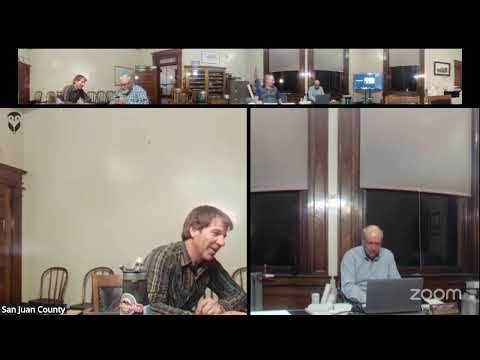
San Juan County hearing draws divided public over proposed County Road 22A improvements and access
Loading...
Summary
Dozens of residents and agency staff spoke at a San Juan County public hearing about proposed improvements to County Road 22A; supporters cited recreation and emergency access, while many property owners raised concerns about trespass, private easements, habitat impacts and lack of notice—commissioners said they would pursue surveys and share findings of fact.
San Juan County commissioners held a public hearing on a proposal to improve County Road 22A and nearby trail segments, hear historic findings of fact and consider possible pedestrian improvements and emergency access.
Commission staff and a commissioner who served on the original task force reviewed the background, saying the concept dates to a 2019 Silverton Area Trails Plan and that earlier public hearings were held in 2020–21. Road staff described a rudimentary proposal that would maintain motorized access where needed, add a pedestrian bridge near Eureka and make modest surface improvements to favor non‑motorized use. "We are here to listen to public comment about this," the chair said, noting that the item was principally an opportunity to gather input rather than to take immediate action.
Public comment was sharply divided. Recreation advocates and local residents urged improvements, saying a maintained non‑motorized route would provide safe walking, winter recreation and trail connectivity. "Trails and natural corridors are our top priority," one commenter said. The county emergency manager, Jim Donovan, told the board the corridor "will provide an alternate emergency access route" from backcountry Eureka, and a paramedic/EMS representative said an alternate route would help evacuations when the main road is cut.
Property owners and neighbors raised a long list of concerns: they said parts of the route cross private parcels, described repeated ATV trespass that damaged wetlands and historic railroad ties, warned of increased illegal camping and human waste, and said avalanche and landslide risk made engineering doubtful without full surveys and design. "I am adamantly opposed to making the trail public," resident Cheryl Meadows told the board, citing wildlife habitat and private‑property risks. Several commenters said they had received little notice beyond the legal newspaper posting and asked for maps and a recorded survey of the right‑of‑way.
Road‑management staff told the board that building a surface usable for grooming or emergency vehicles would require wider construction (staff cited the need to make gates wide enough for equipment roughly 20–22 feet across) and that the county's equipment is designed to build a road rather than a narrow trail. Commissioners and staff discussed gating, signage, a no‑camping policy and the possibility of limiting e‑bike classes (one commissioner suggested capping legal e‑bikes at class 1).
On legal status, staff said the county has findings of fact and historical documentation showing long‑standing use of the route and cited an RS 2477 historical claim; they also said the corridor has not been fully surveyed and that a professional survey and wider distribution of the findings of fact to affected property owners would be appropriate next steps.
After closing public comment, commissioners did not adopt any new access policy. Instead they directed staff to gather additional information, offer property owners the county's findings of fact and proceed with a professional survey before moving toward engineering plans or grant applications. The public hearing was closed.