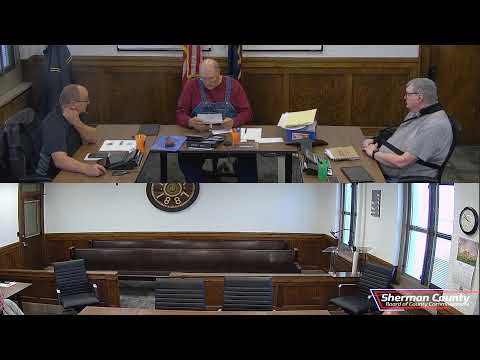
Developer Diego Moreira outlines proposed 350-MW Tox Highway wind project, seeks county coordination
Loading...
Summary
Diego Moreira presented an early-stage plan for the Tox Highway wind project — roughly 350 megawatts sited in northwest Kansas with an intended 345 kV interconnection in Colorado, a projected 2030 commercial operation date and an estimated $50 million-plus in tax revenue across 30 years. Commissioners asked about siting, interconnection and community impacts.
Diego Moreira, a developer representative, told the Sherman County Board of Commissioners the firm is in early lease and permitting stages for the Tox Highway wind project, which the team currently estimates at about 350 megawatts and said could provide long-term tax revenue benefits to the county. “We can expect over $50,000,000 over the 30 years,” Moreira said, characterizing that figure as a long-term projection based on comparable regional projects.
The project team said it currently holds site control for more than 30,000 acres in the area and is pursuing an interconnection to a 345 kV substation located across the Colorado line in Cheyenne County. Moreira said the timeline envisions beginning permitting and interconnection steps this year, with construction hoped to begin around 2028 and commercial operation in 2030 if milestones are met.
Why it matters: The project could produce long-term tax revenue and temporary construction jobs but will require county permitting, environmental and radar-impact studies and an interconnection agreement with utilities in Colorado. Commissioners and county staff pressed the developer on several technical and community-impact issues.
Details, claims and company commitments: Moreira described the company’s community engagement plans and restoration commitments for county roads, saying the developer typically restores roads “to the same conditions or better” after construction. He said the team is conducting environmental and radar-interference studies begun in 2025 and continuing in 2026; the developer plans to collect at least two years of meteorological data before final siting decisions.
On turbine counts and layout, the company gave a wide preliminary range and said final numbers will depend on turbine size and energy-assessment modeling. Moreira acknowledged uncertainty in some figures and told commissioners the final turbine count and precise footprint will be set after site studies and supplier choices are complete.
Questions from commissioners and staff focused on: setbacks and spacing between turbines for safety and production, whether transmission lines will be underground or overhead (developer said smaller collector lines will be underground; higher-voltage lines to the substation will likely be overhead), potential impacts to radar and defense systems (the team is obtaining revised studies and will pursue mitigation or avoidance where necessary), and the role of federal tax credits (the developer said available tax credits are an important factor and that some incentives are scheduled to change around 2030).
Economic and community effects: The developer estimated a construction workforce “around 400, 500 people” during peak build-out and said there may be a small number of permanent local jobs once the site is operational. Moreira described community benefit options including donations, sponsorships and targeted investments in local services.
What’s next: The developer said it will return to the county for approvals related to meteorological towers and other permits and encouraged landowners or residents with concerns to raise them now so the team can attempt negotiated solutions such as good-neighbor agreements.
Attribution: Quotes and attributions in this article come from Diego Moreira and exchanges recorded in the meeting transcript. The board’s discussion and questions were credited to county commissioners and staff present at the meeting.
Ending: Commissioners thanked the team for the presentation and invited follow-up materials and more detailed maps; no formal county action on the project was taken at the meeting.