Get Full Government Meeting Transcripts, Videos, & Alerts Forever!
Get email alerts on the Rent Price Fixing topic
No spam. Unsubscribe anytime.
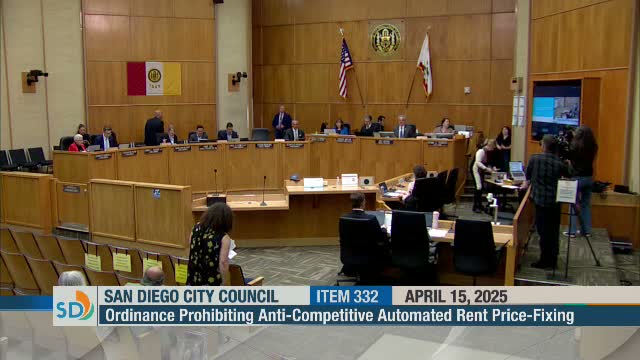
San Diego Council bans algorithmic rent‑setting tools in 8–1 vote
Summary
The City Council approved an ordinance prohibiting software that uses non‑public competitor data from two or more landlords to recommend rental rates or occupancy levels, citing DOJ complaints and local affordability concerns. The measure passed 8–1 after extensive public testimony and technical amendments.
San Diego’s City Council voted 8–1 on April 15 to ban the local use of automated rent‑setting software that relies on non‑public competitor data to recommend rental rates, a step council leaders said is necessary to protect renters from coordinated, algorithmic price hikes.
Councilmember Elo Rivera, who sponsored the ordinance, said the issue affects affordability across San Diego neighborhoods. “This software weaponizes otherwise private data from competing landlords to figure out just how high they can push prices,” Rivera said during debate, arguing that local action was needed alongside federal and state enforcement.
The ordinance defines an "algorithmic device" as software that uses one or more algorithms to process non‑public competitor data from two or more landlords to advise or recommend rental rates or occupancy levels for residential property in the City of San Diego. The draft includes explicit carve‑outs for published market reports that do not recommend rental rates, for software used solely to comply with affordable‑housing program rules, and for appraisal tools that do not recommend rents during runtime.
Supporters, including Legal Aid Society San Diego, labor unions and tenant groups, urged the council to pass the ordinance now rather than wait for federal court outcomes. Gil Verma of the Legal Aid Society said algorithmic price coordination “creates an incentive for landlords to evict tenants in order to increase rents beyond natural market forces.” Representatives for seniors and community groups warned that even modest algorithm‑driven increases can be catastrophic for fixed‑income residents.
Industry and trade groups urged caution. A vendor representative told the council that pricing tools are market‑analysis products and argued the software does not itself set rents. Mike Semco, who spoke for multiple stakeholders during public comment, warned the draft could be “overbroad” and urged more precise exemptions to avoid unintended impacts on appraisal, financing and housing development tools.
City attorneys and the sponsor refined the draft to focus narrowly on software that (a) uses non‑public competitor data from multiple landlords and (b) recommends rental rates or occupancy levels. City staff cited the Department of Justice complaint filed against RealPage and state attorney‑general activity as evidence of practices that can facilitate price coordination. The council rejected an amendment that would have expanded carve‑outs for benchmarking and removed a 90‑day publication threshold for certain market reports; that proposed change failed 4–5.
The ordinance includes remedies allowing tenants to seek injunctive relief, damages or civil penalties of up to $1,000 per violation in civil court and authorizes the city to enforce the law under existing civil enforcement provisions. City Attorney staff said the ordinance is structured to avoid regulating software that relies only on public data or that is used for bona fide appraisal, benchmarking and affordable‑housing compliance, provided those tools do not recommend rental rates.
The measure passed 8–1, with Councilmember Campio casting the lone no vote. Councilmembers said the law is intended as a local check on a practice they and advocates say has already raised rents in affected San Diego submarkets. Enforcement and monitoring will fall to the City Attorney’s Office and, potentially, tenant lawsuits. Councilmembers and advocates said the action is meant to deter coordinated use of non‑public data while broader federal and state investigations continue.
Next steps: the city attorney’s office and the sponsor’s staff said they will publish guidance for landlords and software vendors on compliance and will monitor litigation at the federal and state levels that name similar practices.