Get Full Government Meeting Transcripts, Videos, & Alerts Forever!
Get email alerts on the Public Safety topic
No spam. Unsubscribe anytime.
Longwood chiefs warn aging stations and proposed firefighter rules will raise costs and staffing needs
Summary
Fire and police leaders told the Longwood workshop that Station 15 and 17 are outdated and that proposed firefighter safety rules (42‑hour workweek) could require roughly 13 additional firefighters and equipment replacement, increasing capital and operating costs substantially.
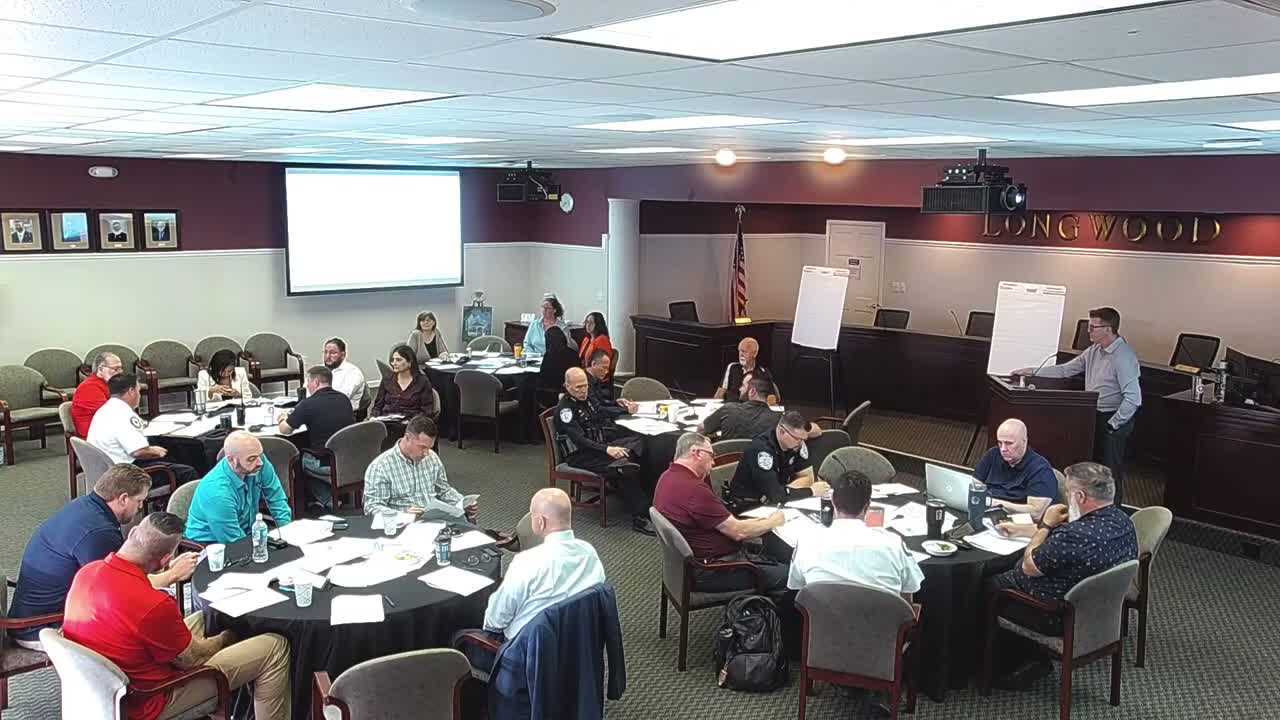
Fire and police chiefs used Longwood’s strategic workshop to press the case that public safety must be prioritized alongside fiscal planning.
Fire Chief Troy Fice told the room Station 15 (built 1980) and Station 17 (built 1984) are functionally obsolete and that Station 17’s footprint was designed for two firefighters, not modern apparatus. "Station 17 was built for 2 firefighters," he said, noting bay and living‑space constraints.
Chief Fice and other speakers also described pending legislative proposals to modify firefighter staffing models. "One of the recommendations in that bill is a 42‑hour work week. We currently work a 56 hour work week," the chief said, adding that implementation could require hiring an additional 13 firefighters depending on rule language and timelines. He also flagged potential PFAS restrictions for bunker gear, noting "a set of bunker gear costs about $5,000."
Police Chief David Douda highlighted retention pressures tied to pay, equipment and facilities: officers notice newer vehicles and apparatus in neighboring agencies and may move for tangible upgrades as well as higher pay. Both chiefs said modern facilities, equipment and predictable funding are critical to recruitment and retention.
Commissioners discussed options including a dedicated public‑safety assessment, bonds or other targeted revenue to fund stations and staffing. Staff were directed to fold public‑safety costs and pension impacts into the financial‑stability modeling for the five‑year plan and to return recommended funding scenarios to the commission.
Next steps: integrate station replacement and staffing scenarios into capital sequencing and the financial model for commission review.