Get Full Government Meeting Transcripts, Videos, & Alerts Forever!
Get email alerts on the Debt Charter Thresholds topic
No spam. Unsubscribe anytime.
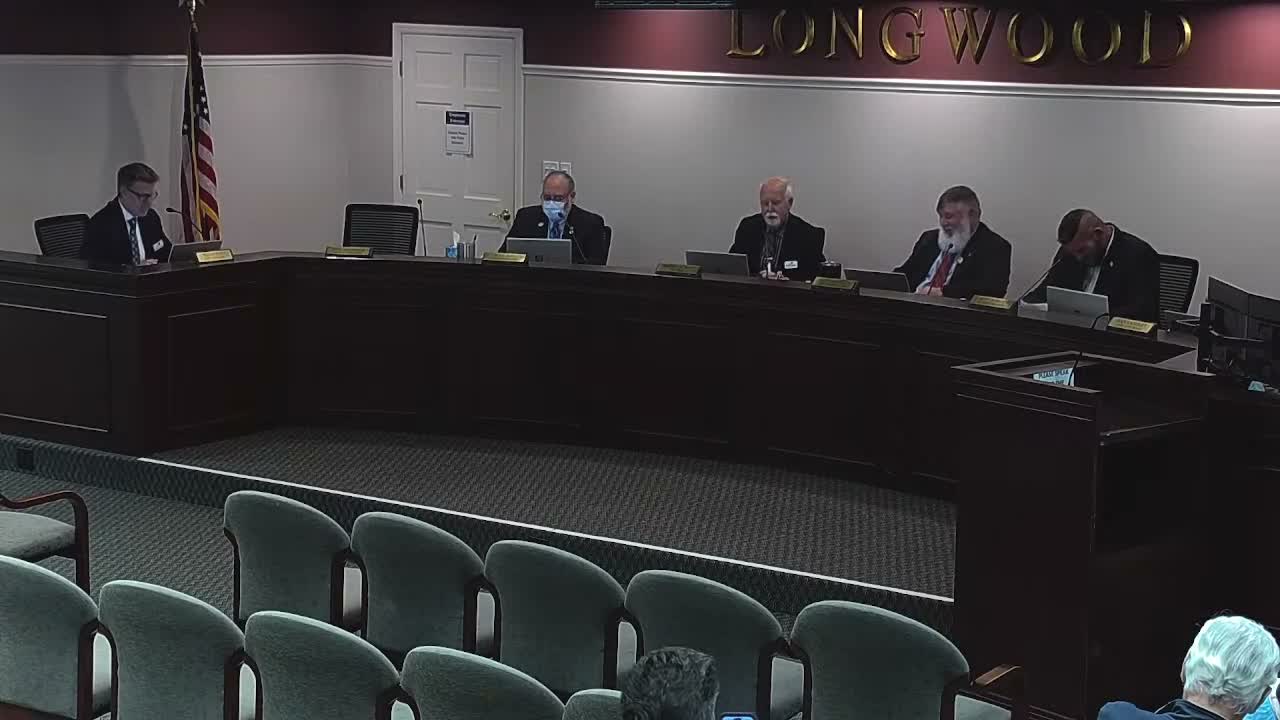
Longwood commissioners ask staff for debt-cap options after wide-ranging charter discussion
Summary
At a Feb. 2 City Commission meeting, staff presented proposed changes to the city charter’s debt thresholds; commissioners discussed borrowing needs for a fire station and water treatment plant and directed staff to propose a public-safety debt ceiling and project priorities for a follow-up meeting.
The Longwood City Commission discussed a proposed charter amendment Feb. 2 that would change how the city authorizes debt for capital projects, then directed staff to return with recommended debt ceilings and priorities.
City Manager Will said the item was for discussion only and would not authorize any borrowing, explaining the current charter requires voter approval for debt exceeding $6,000,000 and staff is proposing a tiered threshold to reflect larger modern project costs. “This item is just for discussion only, does not approve any debt issuance,” Will said, summarizing the proposed framework.
Under the framework staff outlined, borrowing up to $3,000,000 would require three affirmative votes of the commission; $3,000,000–$15,000,000 would require four votes; and any debt above $15,000,000 would require commission approval and voter authorization by referendum, except for certain public-safety capital projects that could be approved unanimously by the commissioners present.
City Attorney Dan Langley reviewed the legal context and noted the difference between city-charter restrictions and state law: state law requires a referendum only for general obligation debt that pledges ad valorem taxes, while other forms of debt may not require a referendum. “The only time Florida law requires a referendum for a debt issuance is when you’re doing a general obligation debt, meaning you’re adding a millage rate onto the tax rolls and you’re pledging ad valorem taxes,” Langley said.
Commissioners pressed staff for concrete cost guidance. Will responded that a new fire station is likely to range from roughly $11 million to $15 million and that staff is looking at creative designs and phasing to limit costs; he said a replacement water-treatment plant could be substantially larger and that the exact numbers would come from the upcoming utility rate study and future project planning. “We are looking at, potentially, $10,000,000 in borrowing for the fire station,” Will said; he later said a full fire-station build could be “anywhere between 11 to $15,000,000.”
Commissioner Morgan urged adding explicit caps to the proposal and recommended carving out a separate public-safety debt ceiling. “The only problem I have with any of this … is there’s no debt ceiling here. We need to cap these projects,” Morgan said, urging the commission to show voters a limit rather than an open-ended authorization.
Commissioner Boney and others argued the discussion belongs in the strategic planning process and that residents should be included in prioritization. Commissioner Boney noted an estimated suite of projects facing the city and urged staff to prioritize public-safety needs alongside financial limits.
After discussion the commission gave staff direction to identify the public-safety projects envisioned for future borrowing, develop a recommended debt ceiling, and return to the commission at the next meeting with those figures and priorities. No charter amendment or vote was taken Feb. 2; the commission’s guidance was to prepare a workshop-level package for further consideration.
Next steps: staff will analyze projected costs and bring recommended debt ceilings and a prioritized list of public-safety capital projects back to the commission for review and potential action.