Get Full Government Meeting Transcripts, Videos, & Alerts Forever!
Get email alerts on the Utilities topic
No spam. Unsubscribe anytime.
Utility consultants tell Milton council current rates leave gap; propose staged reviews and options for connection fees
Summary
Florida Gas Utility presented a preliminary rate study to the Milton City Council, saying current rates (applied to FY2024 usage) would generate about $3.35 million in revenue versus a cited net margin need of roughly $4.16 million — an estimated shortfall of about $814,000 (≈24.3%). The utility recommended further study in June-July and possible rate adjustments effective Oct. 1, 2026, and outlined customer-connection financial tests for new hookups.
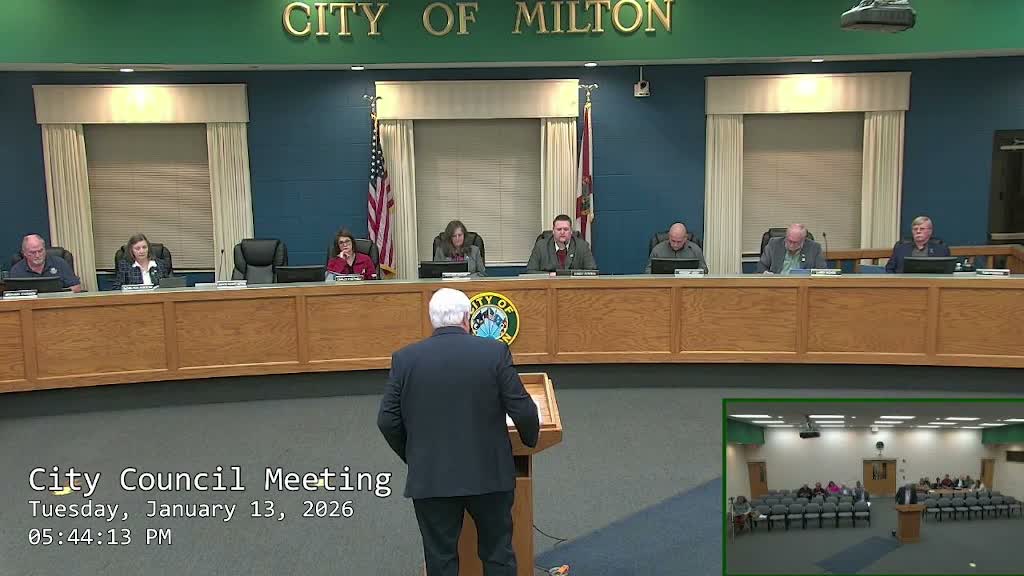
Tom Jeffrey, finance manager and CFO for Florida Gas Utility, told the Milton City Council at its work session that a preliminary rate study using fiscal year 2024 billing determinants and the city’s current rates (effective Oct. 1, 2025) projects roughly $3,349,000 in revenues. He said the gas department’s net-margin revenue target in the FY2026 budget is about $4,163,000, producing an estimated margin shortfall of about $814,000 — roughly 24.3 percent.
The study is an academic exercise, Jeffrey said: “We’re not saying under any circumstance we are $800,000 short in our natural gas budget here tonight. That’s not what this is. It’s just a paper exercise to show you, if you want to adjust your rates, this is the means to go about.” He told council that staff and the utility would revisit the numbers in June or July to set a concrete revenue target and then bring rate proposals for possible implementation Oct. 1, 2026.
Jeffrey emphasized Milton’s current rates are low compared with several peer systems. Using the study’s example for a residential customer consuming 15 CCF, he said Milton’s bill would be about $34.43 per month (before taxes and fees), which was the lowest on the comparison chart he showed. Even under a modeled 24.3 percent increase of the customer and distribution charges to close the modeled shortfall, Jefferson illustrated the typical residential bill would rise to $41.16 and remain on the low end among the utilities compared.
The presentation explained how Milton’s bills are structured: a fixed monthly minimum (customer) charge and a per-CCF commodity/distribution charge. Jeffrey described certain line items that investor-owned utilities may show separately (ECCR marketing trackers, swing-service charges, infrastructure-replacement trackers) that Milton does not itemize in the same way.
Council members asked whether the analysis included expected new customers on a backlog list; Jeffrey said the current report used the existing customer base and that growth scenarios can be modeled in subsequent studies. On expanding service, he recommended a financial-test approach for new connections: estimate appliance-level usage to calculate annual revenue, pick a payback period (the utility recommended five years), and require a new customer to pay up-front any capital cost that would exceed that allowable payback amount. Jeffrey gave a sample calculation showing how a $1,500 connection cost with $200 annual revenue over five years would leave a $500 balance the customer would need to pay.
Mr. Spears (staff) asked council members for guidance so the city can incorporate any policy choices into the coming budget: either defer changes and do another study next year, or ask staff to smooth any needed increase over multiple years. No formal rate action was taken at the work session; staff and the utility will return with refined numbers and recommendations after the June–July review.
Ending: The presenters closed by asking for council feedback before budget preparation; Jeffrey noted he will retire in March and introduced his successor, Steve Prado, who attended the meeting.