Get Full Government Meeting Transcripts, Videos, & Alerts Forever!
Get email alerts on the Human Resources topic
No spam. Unsubscribe anytime.
HR director: Paycom rollout, applicant-tracking cut staffing-agency costs by $367,000; city begins pay study
Summary
At a Milton City Council work session, HR Director Nikki Vickery reported Paycom implementation has yielded $367,000 in estimated savings, improved time-to-fill to 18.8 days, and prompted a three‑phase compensation and classification study; council asked staff to pursue follow-up policy and procurement steps.
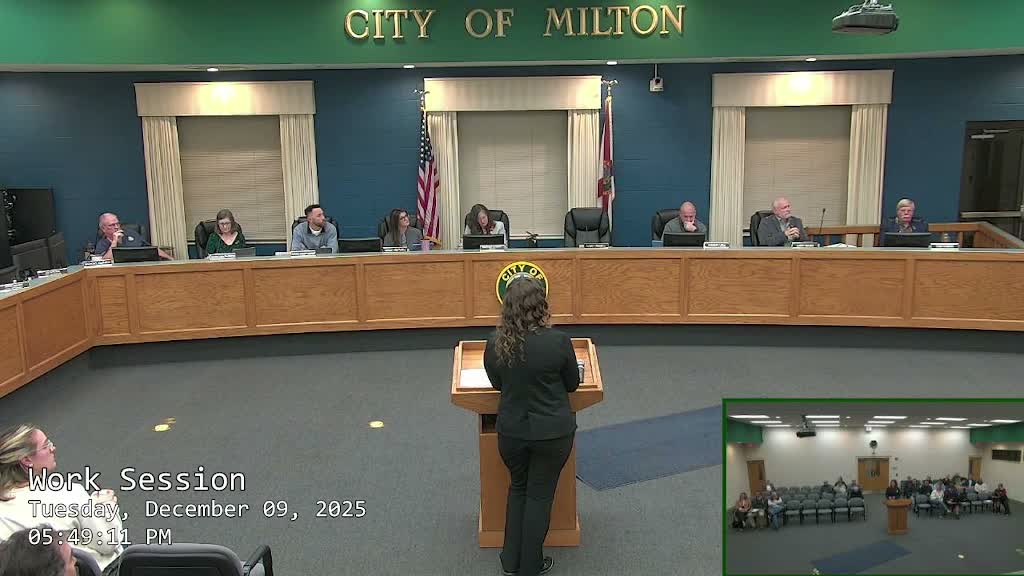
Nikki Vickery, Milton’s HR director, told the council during a work session that the city’s implementation of Paycom and a new applicant‑tracking workflow has produced measurable operational savings and improved recruiting metrics.
"We implemented Paycom in January ... We ended up with ... a reduction now by $367,000," Vickery said, summarizing savings recorded between May and October after applicant‑tracking went live. She said the system eliminated paper processes for payroll, produced one year of usable data, and increased employee self‑service usage.
Vickery said the applicant‑tracking portion of the system went live in May and that the city’s average time to fill vacancies has fallen to 18.8 days, which she described as a strong performance compared with typical public‑sector benchmarks. She told council members the city is on track to remain well staffed and reported a monthly staffing level near 98 percent.
The presentation included a range of HR initiatives beyond Paycom. Vickery outlined partnerships with a local disability‑service group called Vision of Hope to provide on‑the‑job training and with the Veterans Treatment Court to expand community service opportunities. She described employee wellness efforts — a first annual wellness event with roughly 70 percent employee participation — and plans for a Police Department Nutrition Expo and other employee engagement activities.
Vickery also reviewed policy work underway: revisions to the drug‑free workplace policy, establishment of a formal city code of conduct, safety‑program updates including driver classifications and MVR checks, and consideration of a combined PTO model. She framed those changes as the foundation for a three‑phase position classification and compensation study: (1) job‑description and classification review, (2) a vendor compensation study, and (3) pay‑structure redesign and implementation.
Council members asked practical questions about employee equipment and reimbursements. Vickery confirmed the city raised the safety‑boot reimbursement to $200 after learning previous reimbursement levels were insufficient; she said staff would investigate alternate options such as mobile vendors or "boot trucks" that could provide longer‑lasting footwear for employees.
The mayor and council thanked Vickery for a detailed report and for the savings achieved, and council signaled support for staff follow‑up on the compensation study and policy updates.
What’s next: Vickery said staff will return with more detailed proposals for phase‑2 vendor selection and schedule timing for the compensation‑structure redesign.