Get Full Government Meeting Transcripts, Videos, & Alerts Forever!
Get email alerts on the Technology Regulation topic
No spam. Unsubscribe anytime.
Rep. Schlegel’s bill to recognize a 'reasonable care' duty for software providers is reported favorably
Summary
HB190, sponsored by Rep. Schlegel and drafted with the Louisiana State Law Institute, would state that providers of apps and interactive software owe a duty of reasonable care; the committee reported the bill favorably after expert testimony and questions about scope, vicarious liability and content vs. algorithmic design.
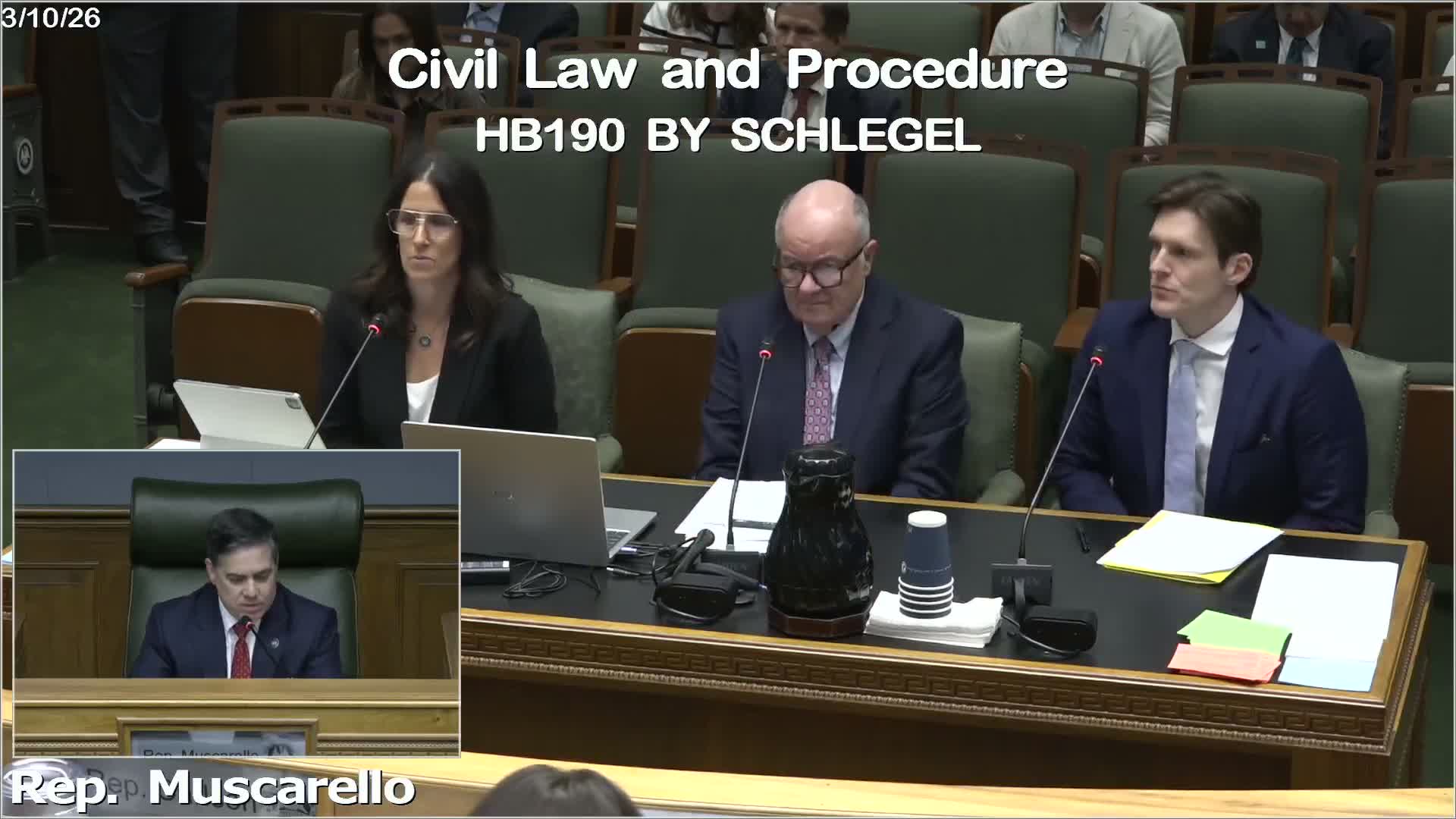
The House Civil Law and Procedure Committee on March 10, 2026 reported HB190 favorably. The bill, presented by Representative Schlegel with experts from the Louisiana State Law Institute, would recognize that a person who provides an application, program or interactive software owes a duty to exercise reasonable care.
Professor Tom Galligan, co‑reporter for the Law Institute’s torts and insurance committee, said the measure is a narrow recognition of duty and does not define breach, causation or damages; those elements would remain for courts to decide under traditional negligence standards. "A person who provides an app, a program, or software that offers an interactive, iterative experience owes a duty of reasonable care," Galligan said.
Nick Kunkel, staff attorney at the Law Institute, told the committee practical litigation considerations make suits against individual employees unlikely and that vicarious liability could make a provider company the primary defendant in most cases. Representative Mellerin asked whether "person" includes natural and juridical persons; witnesses confirmed both.
Committee members pressed on how the bill differs from product liability and whether the statute targets content or algorithmic design. Galligan said the bill is aimed at risks created by the provider’s design or algorithmic curation (for example, systems that recommend harmful material), not ordinary third‑party content, and cited recent case law such as TikTok v. Anderson where courts considered design and recommendation systems in product‑style claims. The panel discussed the tension with Communications Decency Act section 230 immunity and said HB190 does not resolve that federal question.
Representative Edmondson moved and the committee reported HB190 favorably with no recorded objection. The committee noted witness cards in support from Jean Mills, Kathleen Benfield and Tom Costanza, and cards in opposition from Shelley Dupre and Larry Murray.