Get Full Government Meeting Transcripts, Videos, & Alerts Forever!
Get email alerts on the Criminal Justice topic
No spam. Unsubscribe anytime.
House approves new penalties for disturbances during worship, including 30-day minimum jail term for misdemeanor
Summary
The Louisiana House passed HB68 after a lengthy floor debate over a provision that creates a misdemeanor offense for disturbing a worship service with a mandatory 30-day jail minimum and enhancements that can convert related conduct to a felony punishable by up to two years.
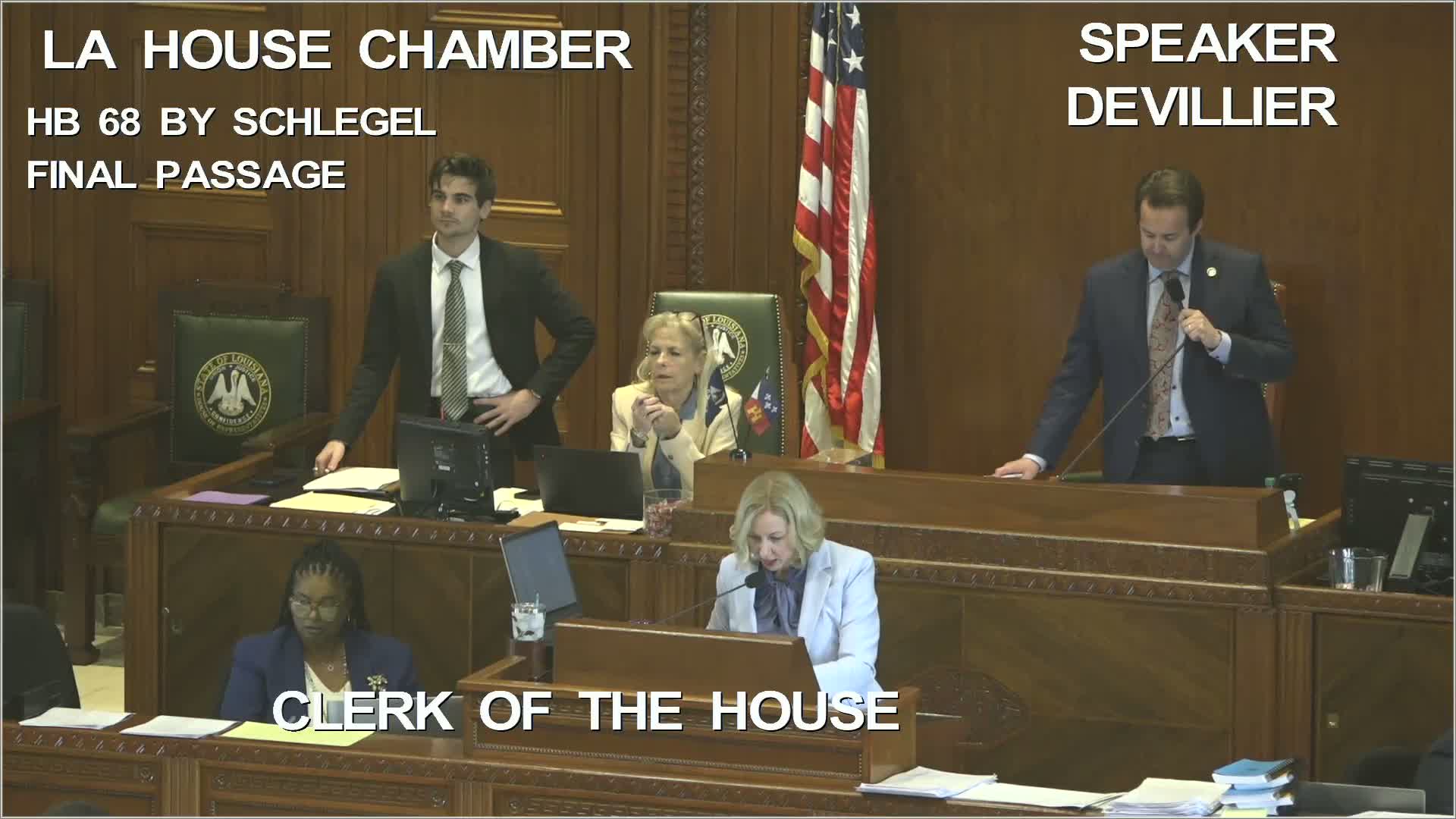
The Louisiana House of Representatives on March 24 approved House Bill 68, a measure that creates a distinct offense for interfering with a worship service and imposes a mandatory minimum 30-day jail sentence for certain misdemeanor violations, along with enhanced penalties that can elevate related conduct to a felony.
Representative Glorioso, the bill’s sponsor, told the chamber the proposal is meant to protect “houses of worship” defined by federal statute and to deter conduct that could escalate into violence. “I do consider that a church is a sacred place, and we should respect everyone in this church and everyone while they're in church,” Glorioso said during floor remarks. He framed the bill as a deterrent to disruptions that could lead to harm or impede a congregation’s ability to worship.
Opponents asked detailed questions about how the law would operate in practice. Representative Jordan posed a hypothetical to underline concerns about vagueness: if someone were to “start singing Amazing Grace in the middle of a priest’s homily,” could that person face 30 days in jail? “And now I'm going to jail for 30 days?” Jordan asked during questioning, illustrating the worry that the bill’s language could capture innocuous conduct. Representative Mandy Landry, Representative Green and others pressed the sponsor on when the statute would be triggered, who would make the factual determination, and whether current crimes (trespass, disorderly conduct) already cover the conduct the bill targets.
The bill defines the covered locations by reference to federal law (the transcript cites 26 U.S.C. §501 as the governing definition of recognized houses of worship) and establishes a range of penalties. Under the text discussed on the floor, the misdemeanor carries a mandatory minimum of 30 days and a fine of up to $500; specified aggravating factors would raise the offense to a felony carrying penalties up to two years. The sponsor said felony enhancements are subject to judicial discretion at sentencing, while the misdemeanor provision includes the mandatory minimum.
Supporters pointed to recent attacks on houses of worship around the country and said the measure is preventive: “We often pass laws to prevent crime,” the sponsor said, adding the intent is to deter interruptions that could escalate. Critics argued the mandatory minimum for a misdemeanor is an outlier in Louisiana’s sentencing structure and flagged potential constitutional or enforcement issues. Multiple members noted the role of law enforcement discretion and the requirement that alleged incidents be reported and investigated before charges would be brought.
After roughly an hour and a half of questions and back-and-forth on definitions, intent and penalties, the House adopted the bill on final passage by a recorded vote of 70 ayes and 31 nays. The bill will proceed according to the legislative process for enrollment and transmittal to the Senate or to the next procedural step as required by chamber rules.
Votes: HB68 final passage — 70 ayes, 31 nays.
The House discussion ended with members returning to the calendar and continuing other business; the bill’s sponsor said he would continue to engage colleagues about language and enforcement concerns as the bill moves through subsequent steps.