Get Full Government Meeting Transcripts, Videos, & Alerts Forever!
Get email alerts on the Comprehensive Plan Update topic
No spam. Unsubscribe anytime.
Naples council, planning board review comp‑plan outreach; consultants recommend resilience element and more green‑space guidance
Summary
At a Jan. 20 joint workshop, City of Naples staff and consultants reviewed round‑1 outreach for the Naples 2045 comprehensive plan update and proposed a hybrid approach that adds a dedicated resiliency element and stronger guidance on lot coverage, impervious area and green‑space policy. Council asked consultants to refine survey questions and broaden resident outreach before February workshops.
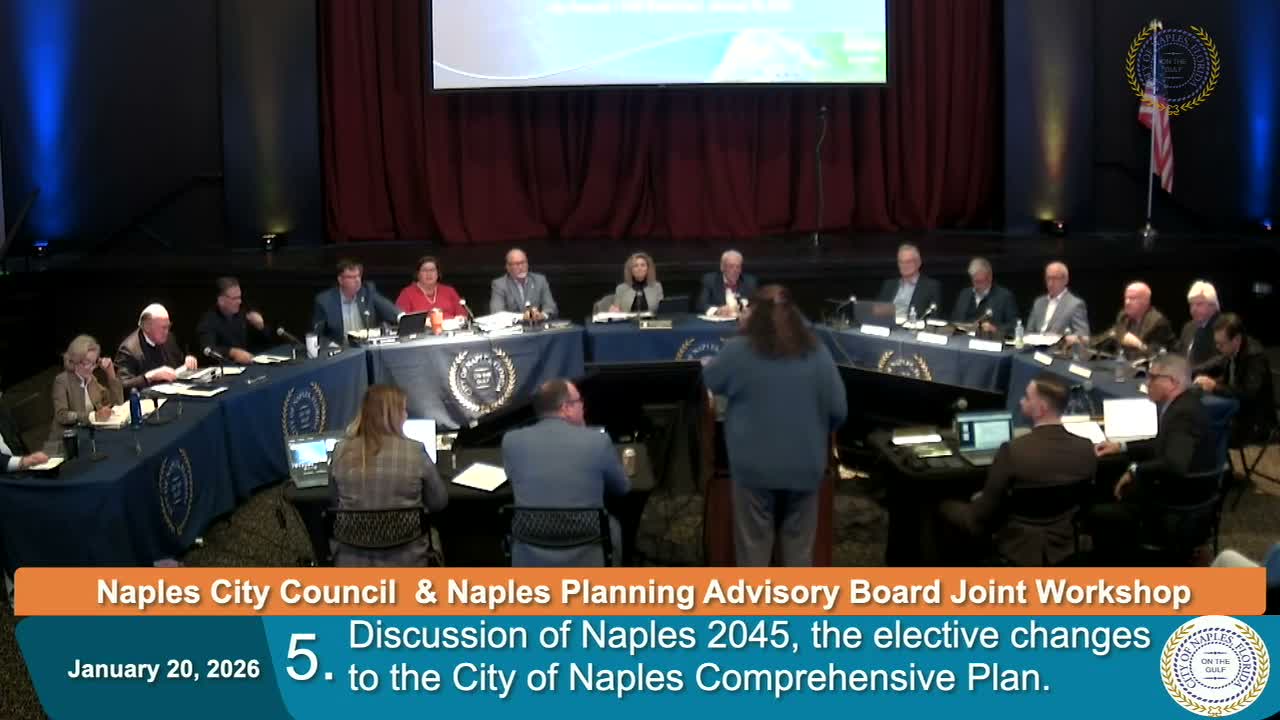
The City of Naples held a joint workshop of city council and the Planning Advisory Board on Jan. 20 to review progress on the Naples 2045 comprehensive plan update and to refine public outreach ahead of the next round of workshops.
Consultants from Johnson Engineering and Clarion Associates reported that the round‑1 questionnaire (Nov. 6–Dec. 6) plus two in‑person workshops produced roughly 1,000 combined responses and strong participation from older residents and property owners, but lower turnout among full‑time year‑round residents in some neighborhoods. "We were surprised by the volume of responses and we can identify and limit duplicates," said Christine Fisher, the project manager with Johnson Engineering. Staff and the consultant team said they will refine outreach and the questionnaire to attract more residents before two drop‑in workshops scheduled for Feb. 12.
The meeting moved quickly from outreach statistics to policy themes. Consultants described three technical focus areas raised by respondents: community character (including lot coverage and building massing), the so‑called "Green Jewel" concept for more public green space and resilient landscaping, and resiliency measures to address flooding, sea‑level rise and storm impacts. "We see opportunities to add guidance on lot coverage, impervious area limits and open‑space requirements," Clarion Associates planner Leanne King told the group.
Resiliency expert Erin Dady recommended a hybrid approach: create an optional, standalone resiliency element in the comp plan to collect and highlight vulnerability and adaptation policies, while also inserting targeted resiliency policies across other elements (for example, capital improvements and parks) so projects and funding decisions reflect flood‑risk priorities. "An optional element gives you flexibility and lets you brand a comprehensive resiliency approach while still putting key implementation policies where they belong," Dady said.
Council members pressed on timing and legal limits. Questions focused on aligning comp‑plan guidance with the city’s existing zoning and charter rules, and on how statewide measures such as the Live Local Act might affect allowable heights for affordable housing projects. Planning director Eric Martin and the consultants emphasized that policy language in the comp plan would be advisory rather than a substitute for the city’s zoning code, but that clarifying policy in the plan can help guide consistent ordinance and permitting decisions.
On outreach logistics, staff proposed a mailed flyer with a QR code linking to the revised questionnaire and two Feb. 12 drop‑in workshops (United Church of Christ, north, and Norris Community Center, south). City staff agreed to circulate a revised set of questionnaire items to council and PAB members for quick comment and to return edits by the requested deadline so the schedule toward draft amendments in March and PAB review in March/April is preserved.
The workshop concluded with staff committing to refine outreach methods, finalize the flyer and questionnaire, and present drafted amendments to the Planning Advisory Board for formal recommendations before coming back to council. The council and PAB will continue to weigh trade‑offs between community character, property‑rights concerns and resiliency needs as the draft plan is prepared for public review.