Lifetime Citizen Portal Access — AI Briefings, Alerts & Unlimited Follows
Committee defers bill that would bar higher pricing for insured property-damage repairs
Loading...
Summary
House Bill 831, which would prohibit charging higher prices for repairs when a customer uses insurance and restrict selective use of estimating databases, was voluntarily deferred so the market advisory board can study the issue and convene stakeholders.
Miss Johnson read House Bill 831, a proposal that would prohibit charging different prices for the same product or service based solely on whether the customer is using insurance and that would narrow inconsistent use of automated estimating tools in property-damage claims.
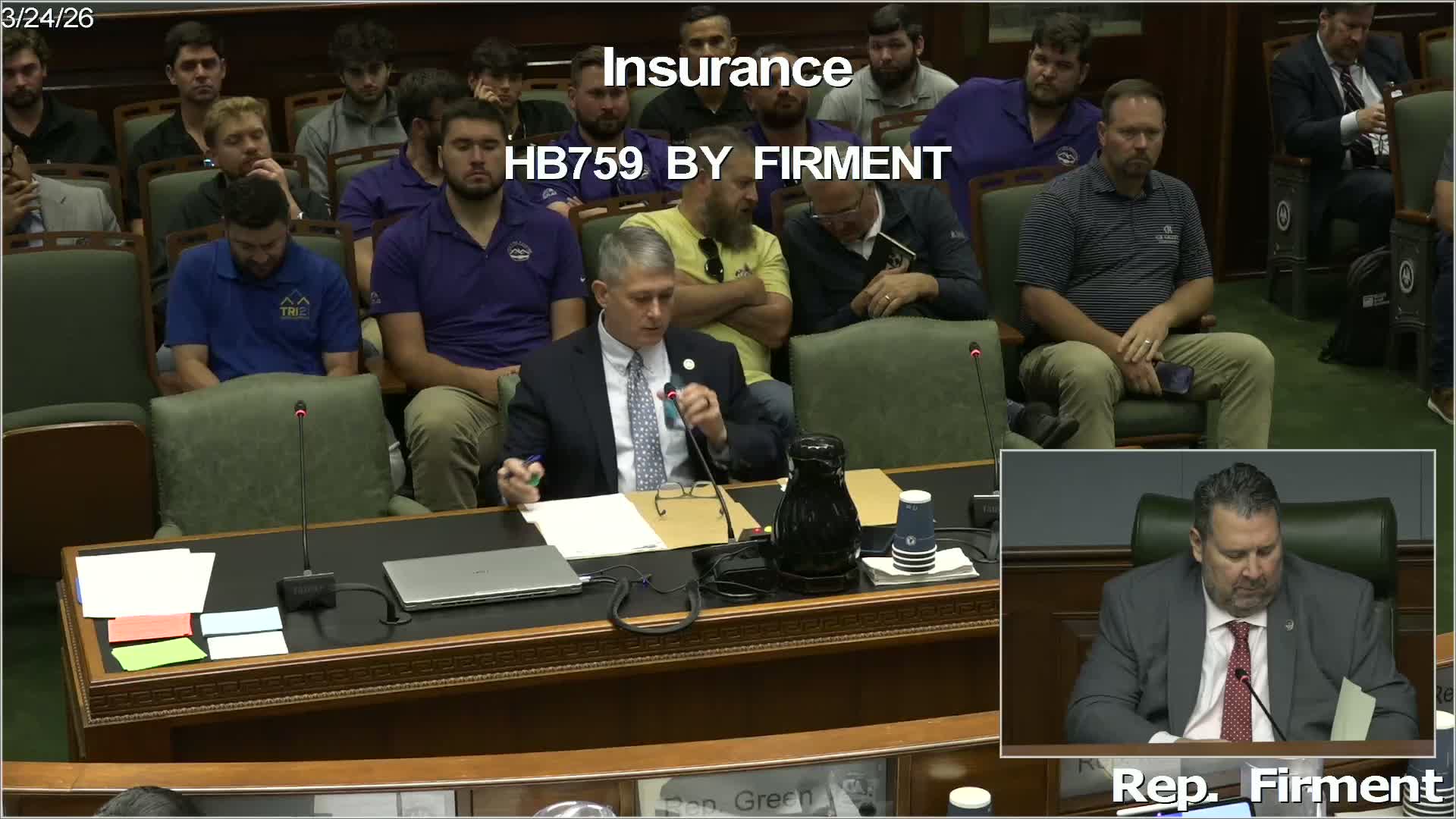
Chairman Furman framed the bill as aimed at homeowners caught between contractors and insurers after storms and said the measure seeks “fairness and transparency.” Numerous industry representatives filed opposition cards and came to the table to testify.
Keller Matthews (State Forum) cautioned that defining a pattern of practice could raise regulatory costs and unintended consequences. Jonathan Davis, secretary-treasurer of the Residential Roofing Association and owner of Gator Roofing and Restoration, testified that the bill risks increasing disputes and litigation if it changes how contractors price jobs without ensuring insurers fairly consider contractor estimates. He urged the committee to require carriers to fairly evaluate retail or contractor estimates if the committee restricts how contractors price insurance work.
A Farm Bureau witness and insurer representatives disputed the portrayal of some estimating tools, explaining that some platforms provide guaranteed material prices and ordering instructions and describing estimating tools as part of a broader claims toolbox. Members expressed confusion that insurers and contractors were opposed to different parts of the measure and said more stakeholder engagement was needed.
Chairman Furman proposed asking the Market Advisory Board to convene stakeholders and study the bill’s practical effects. He moved to voluntarily defer HB 831 for further work; seeing no objection, the committee deferred the bill so the advisory board can examine issues and help craft legislation in a future session.
Next steps: HB 831 will be held for further study and stakeholder engagement; the Market Advisory Board will be asked to convene interested parties.