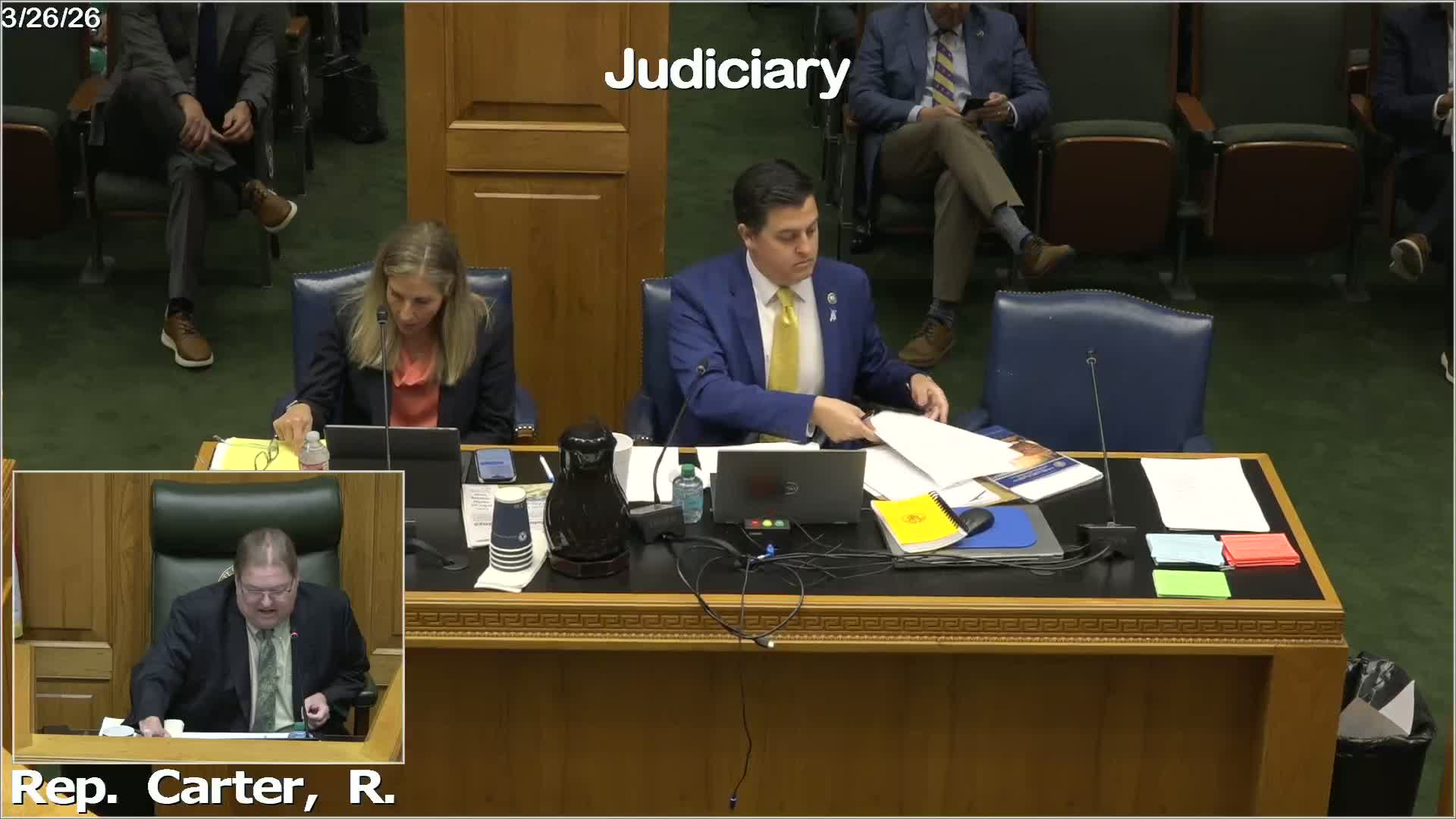
House panel advances bill to consolidate Orleans Parish courts after hours of testimony
Loading...
Summary
The Louisiana House Judiciary Committee voted 10–5 to report House Bill 911 out of committee, approving amendments to consolidate Orleans Parish civil and criminal district courts and create a single clerk system. Supporters cited long-running studies and potential savings; judges and civil‑justice advocates warned of scheduling, data and service risks.
Representative McMakin pressed the committee to approve House Bill 911 on March 26, saying the measure continues a two‑decade effort to align Orleans Parish’s court structure with the rest of the state. “Today's House Bill 911 is a continuation 20 years in the making, going back to 2006 for the Orleans court system,” the bill’s author told the House Judiciary Committee, arguing consolidation would create a single judicial district and clerk system and save taxpayer dollars.
Opponents — including New Orleans practitioners, civil‑rights groups and sitting judges — urged caution. Sarah Whittington of the ACLU of Louisiana, who testified in opposition, said the committee should not rely on older data alone: “Without knowing and without having anything since 2011, we would have serious concerns about what is and is not accurate,” she said, noting differences in how clerks report cases across parishes and arguing that Orleans still handles one of the highest volumes of jury trials in the state.
Judges and the Orleans clerk described the practical effects consolidation would have on everyday courtwork. Judge Kern Reese said the civil docket in New Orleans contains complex, time‑consuming matters — “That 9‑week asbestos trial that Mr. Harrison mentioned, that was my case,” he said — and warned that eliminating judgeships would push trial dates years into the future. Clerk Chelsea Richard Napoleon told lawmakers that parts of the bill would reverse prior consolidations in ways that could shift control of self‑generated clerk funds and affect office operations and staff.
Members of the committee repeatedly pressed the bill’s author for details about the fiscal effect and the data behind the proposal. The author said the Louisiana Supreme Court’s weighted caseload analysis and other studies dating to 2006 informed the proposal and that the state currently makes a direct payment into Orleans criminal court operations. He cited a figure of roughly $7,000,000 in direct state support to the criminal court but said a complete total budget for the courts was not available in the fiscal note.
The hearing included several contested procedural moves. Members adopted a three‑minute speaking rule early in the session, and later a motion to suspend that rule failed after a tie vote and chair action to break the tie. The committee also considered a large set of technical amendments (set 2142, described in committee as mostly technical) and adopted them by voice/roll call after the author and staff described the changes.
After extensive testimony from proponents, opponents and informational witnesses — including local judges, the clerk of court and practitioners — the committee voted 10–5 to report HB 911 favorably as amended and send it on in the House process. The vote record was announced by the committee secretary during the hearing.
What happened next The committee reported the bill favorably to the full House with adopted amendments. Lawmakers and several witnesses asked for additional, parish‑specific analysis and clearer, standardized case‑count reporting by clerks; proponents said multiple studies support the proposal and urged prompt action.
Why it matters Supporters framed HB 911 as an efficiency and fiscal‑responsibility measure to bring New Orleans into alignment with other judicial districts. Opponents said consolidation could lengthen trial waits, undermine specialized dockets (asbestos, maritime and class actions) and disrupt clerk‑funded services and employees without a current, uniform data standard across parishes.
The committee did not make a final determination on every implementation detail; the bill was reported out of committee and will proceed to the House calendar for further action.