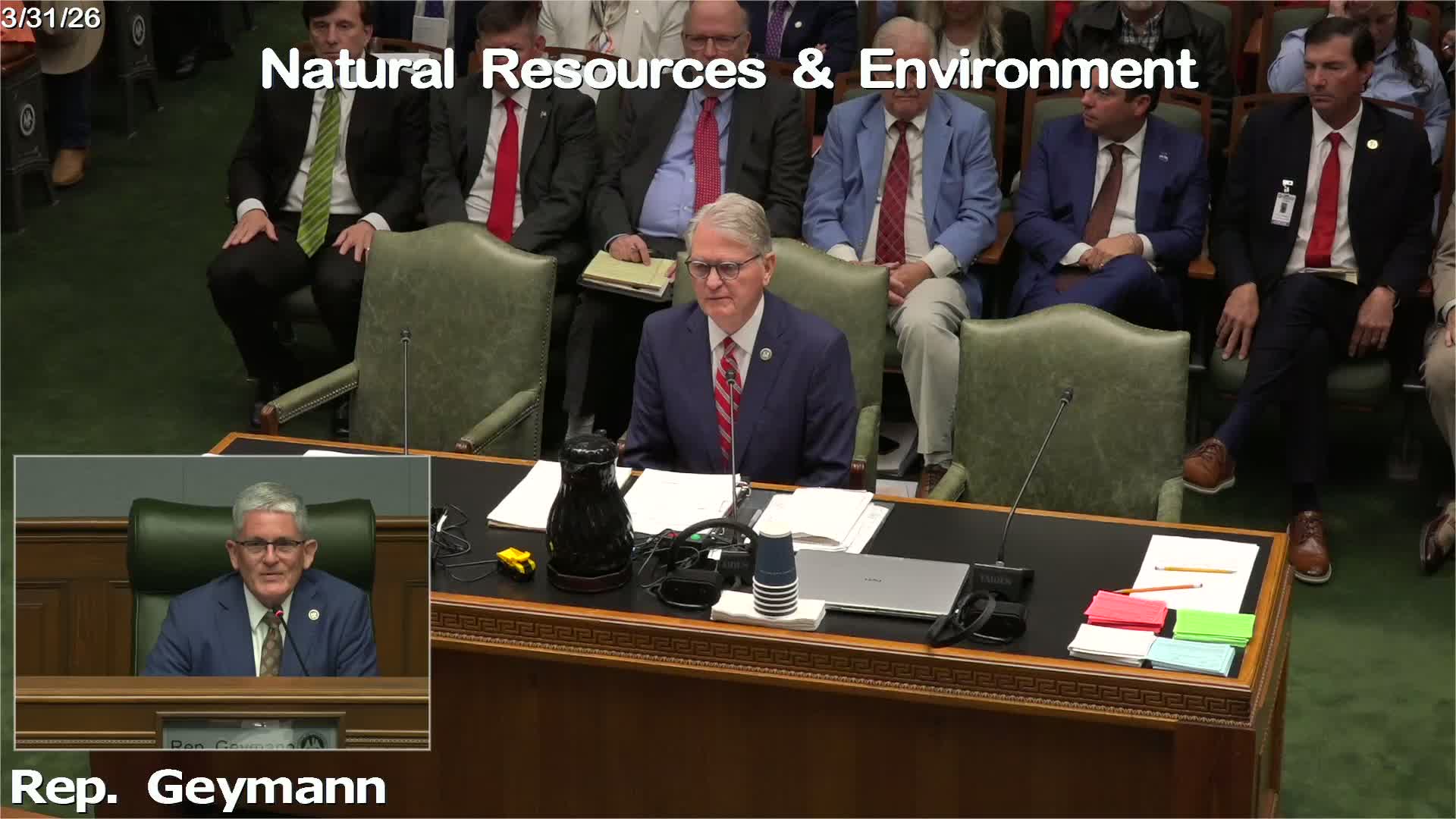
House committee hears bill to bar private carbon‑capture companies from using eminent domain; bill involuntarily deferred
Loading...
Summary
The House Natural Resources Committee debated House Bill 7, the Louisiana Landowners Protection Act, which would prohibit private carbon‑capture companies from exercising eminent domain for CO2 pipelines and storage. After hours of testimony from the bill sponsor, constitutional experts, industry, and dozens of citizens, the committee failed to move the bill forward and involuntarily deferred it.
Speaker Pro Tem Mike Johnson introduced House Bill 7, the Louisiana Landowners Protection Act, telling the House Natural Resources Committee the measure would prevent private carbon‑capture companies from using eminent domain to acquire land for CO2 pipelines and long‑term storage and would preserve property rights guaranteed by Louisiana’s constitution.
The bill’s sponsor framed the proposal as corrective: "This bill removes the unusual and extraordinary power" that allows private companies—"not for a public purpose"—to compel landowners to sell, he said, and added that projects can proceed through voluntary agreements. Johnson repeatedly cited Louisiana Constitution Article 1, Section 4 and recent state court rulings in arguing that the constitution, not a statute, must control takings.
Why it matters: supporters said HB 7 would protect small landowners, generational family farms and parish autonomy from coercive bargaining and litigation costs; opponents said it would strand planned investments, complicate large infrastructure projects and threaten jobs. Industry witnesses including the Louisiana Mid‑Continent Oil & Gas Association and Louisiana Chemistry Association told the committee that pipelines and sequestration projects require assembling rights across many parcels and that removing eminent domain authority could deter billions of dollars of announced investment.
Witnesses and main arguments: constitutionalists Woody Jenkins and attorney Paul Hurd recounted Louisiana’s post‑Kelo constitutional amendments and said private expropriation for CCS conflicts with the state’s limited list of public purposes. Industry witnesses (Tommy Fauciate, David Cresson, Mike Montcla) said expropriation is used rarely but is an essential last‑resort tool for assembling long, continuous rights‑of‑way, and warned that singling out CO2 infrastructure would create unpredictability. Lawyers from Jones Walker described statutory safeguards and judicial review, saying courts determine whether a taking is a public and necessary purpose.
State agencies—Louisiana Economic Development and the Department of Conservation and Energy—testified for information: LED warned that predictability affects capital flows and said many investment decisions are watched globally; the Department explained the pipeline certification and unitization processes and emphasized that a certificate does not itself take land—it authorizes an entity to seek a judicial determination if necessary.
Public testimony: dozens of landowners, parish officials and grassroots groups opposed HB 7, telling the committee they feared landmen’s pressure, potential health or property value impacts from underground CO2 storage, and the practical burdens of defending takings in court.
Committee action: after extended questioning and public comment, Representative Reiser moved to report the bill favorably. The committee roll call recorded 7 ayes and 12 nays on a motion to move the bill favorably; that motion failed. Representative Reiser then moved to involuntarily defer the bill; there being no objection, the committee involuntarily deferred HB 7.
What was decided and next steps: the committee did not advance HB 7; the involuntary deferral removes it from immediate consideration in this committee. If the sponsor pursues further action, the bill could return with amendments or be refiled in a later session. Chairing members and agency witnesses noted that ongoing litigation and court decisions may further clarify constitutional limits on expropriation for private CCS projects.
Vote at a glance: Motion to report HB 7 favorably — failed on roll call, 7 ayes, 12 nays. Motion to involuntarily defer — passed without objection.
Representative and speaker list (attributed quotes in this article): Speaker Pro Tem Mike Johnson (bill sponsor); Woody Jenkins (former state representative); Paul Hurd (attorney); Tommy Fauciate (Louisiana Mid‑Continent Oil & Gas Association); David Cresson (Louisiana Chemistry Association); Mike Montcla (Louisiana Oil & Gas Association); Paige Carter (Louisiana Economic Development); Dustin Davidson and Blake Canfield (Department of Conservation & Energy); many local landowners and parish officials.
The committee adjourned and the bill remains involuntarily deferred for potential further consideration.