Get Full Government Meeting Transcripts, Videos, & Alerts Forever!
Get email alerts on the Judicial Career Collegiality topic
No spam. Unsubscribe anytime.
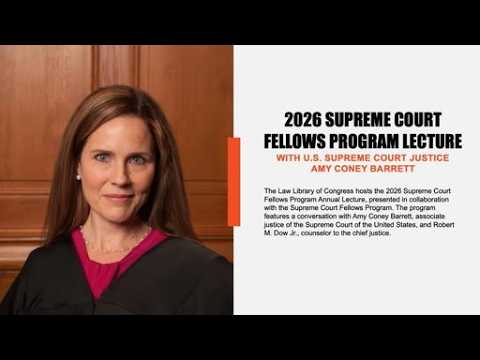
Justice Amy Coney Barrett emphasizes mentorship, collegiality and constitutional interpretation at Library of Congress lecture
Summary
At a Law Library of Congress lecture for the Supreme Court Fellows Program, Associate Justice Amy Coney Barrett discussed her career path, the role of mentorship and collegiality on the bench, and how the Constitution’s general language promotes durability while leaving policy details to legislatures.
Associate Justice Amy Coney Barrett spoke at the Library of Congress’ Coolidge Auditorium as part of the 2026 Supreme Court Fellows Program lecture, offering reflections on her upbringing, clerkships, academic work and life on the Supreme Court. The event was introduced by Law Librarian Aslihan Bulut and Judge Robert M. Dow Jr., counsel to the chief justice and Executive Director of the Fellows Program.
Barrett framed her childhood in New Orleans as formative, saying, “When I think about New Orleans, I think about family and food and fun,” and noting the city’s extended Mardi Gras traditions. She described how a large family shaped her priorities and influenced her decision‑making about career and family life.
On mentorship and early training, Barrett recounted clerking for Judge Lawrence Silberman and for Justice Antonin Scalia, describing intense interview and clerking practices. She said the experience taught her to be constantly prepared and to value mentors who helped her navigate judicial work. “Judge Flom took me under his wing,” she said, citing judges and colleagues who served as professional guides.
Barrett discussed collegiality as an intentional choice. Referencing her own book’s maxim that “collegiality is an act of will,” she said justices need to decide to cultivate relationships and, as one practical example, to have lunch together after difficult conferences so disagreements do not harden into personal rifts.
On decisionwriting, Barrett said she generally prefers majority opinions to speak for the court and writes separate concurrences or dissents sparingly—often when assigned by senior dissenters or when she believes an explanation will aid legal development. She described John Marshall’s approach to producing a single opinion for the court as an institutional model that helped strengthen the Court’s role.
Turning to constitutional interpretation, Barrett argued the Constitution’s longevity is tied to its mix of specific and general provisions. She contrasted the U.S. document with more detailed constitutions abroad and said leaving policy specifics to legislatures allows the system to adapt: “Most of the Constitution is written in more general terms,” she said, adding that this design delegates detailed policymaking to the legislative process.
Barrett used personal family materials—letters preserved after Hurricane Katrina—to illustrate the importance of historical context and vocabulary in textual interpretation. She said such context helps explain how words were understood by their original users and informs textualist or originalist analysis.
Addressing young lawyers and law students in the audience, Barrett counseled deliberate career choice given the time and expense of legal training and encouraged those who truly want a legal career: “If you decide that it is, I’m bullish,” she said.
Barrett closed by describing the practical role of law clerks—four in her chambers—who divide caseloads, draft memos, research and help manage emergency motions. The moderator, Judge Dow, thanked Barrett and the audience for attending.
The lecture combined personal memoir, practical advice on mentorship and courtcraft, and a defense of textual/contextual approaches to constitutional interpretation. The program also formally introduced the 2026–27 Supreme Court fellows prior to the conversation.