House committee advances bill requiring notification for in-person recordings, with exceptions
Loading...
Summary
The House Civil Law Committee on March 30 advanced HB 410, which would require participants in an in-person direct conversation to be notified if the conversation is being recorded or transcribed, while carving out exceptions for first responders, evidence preservation and recordings by participants in their own residence; the committee adopted a substantial amendment set and reported the bill as amended.
House Bill 410, presented to the House Committee on Civil Law and Procedure on March 30, would require notification — not consent — for a participant who records or transcribes a direct, in-person conversation, and would create a civil path for people harmed by secret recordings.
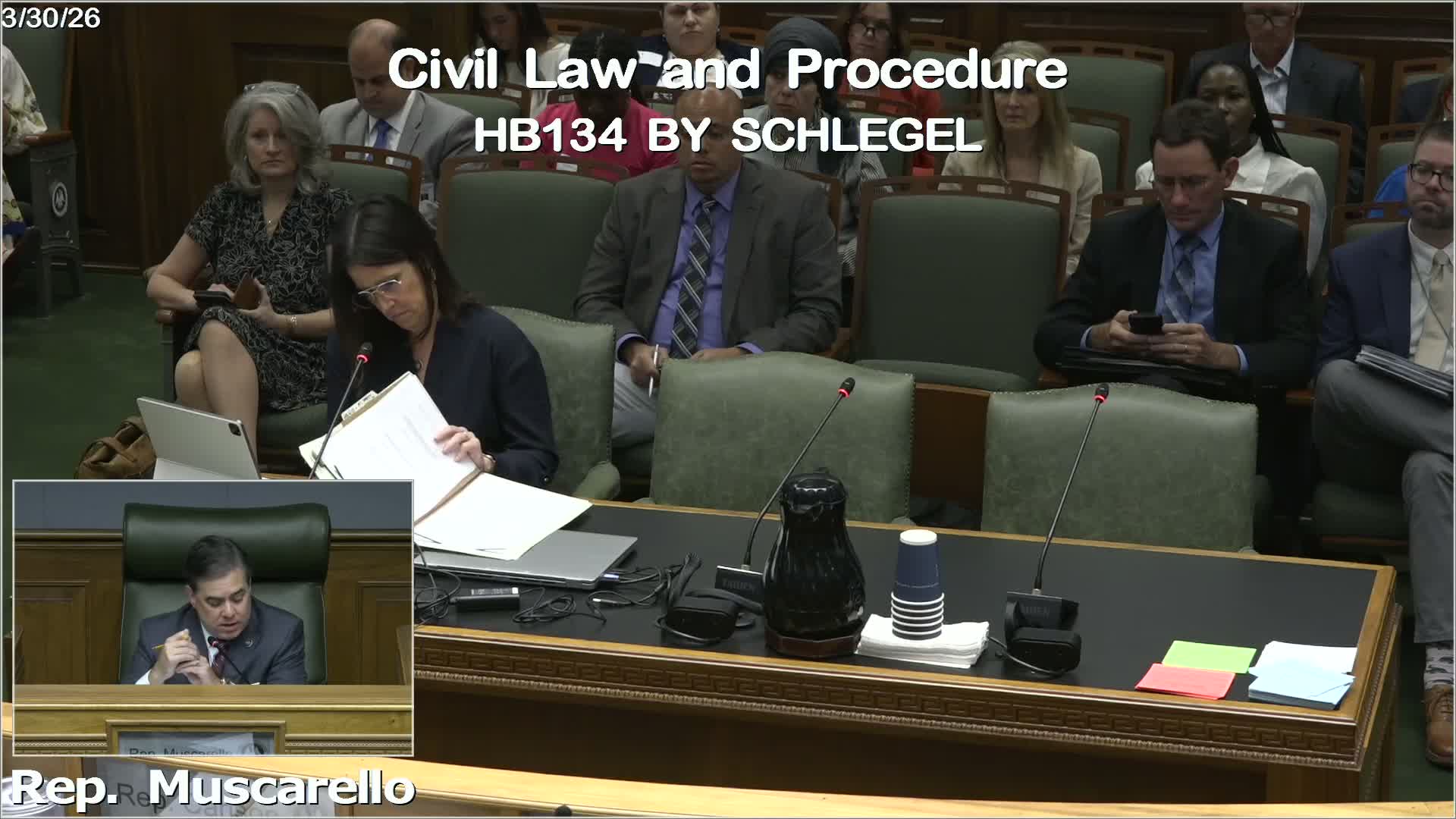
Chairwoman Schlegel, the bill sponsor, said the legislation is a “measured approach” to protect reasonable expectations of privacy in the era of discreet wearable cameras and other devices. She told the committee the bill mirrors notification statutes in other states and is intended to address viral videos that have harmed people who did not know they were being recorded. “This bill does not require consent to record. It simply requires notification,” Schlegel said in committee.
An amendment set (2,713) adopted by the committee made technical and substantive changes: it removed language tying the standard to a reasonable-person test about overhearing vs. recording, clarified that all participants in the direct conversation must be notified if recording or transcribing is occurring, defined and exempted first-responder activities, narrowed the scope for transcriptions made to preserve evidence for civil, administrative or criminal proceedings, and removed prior algorithm restrictions and some penalty language. Miss Alonzo read the amendment set into the record before it was adopted by unanimous consent.
Opponents and witnesses who testified in opposition said the bill could impede legitimate one-party recordings used to protect vulnerable people or to preserve evidence. Sarah Dyson, a notary who testified in opposition, described using a recording to document suspected elder abuse during a reverse-mortgage signing; she said because Louisiana is currently a one‑party‑consent state she was able to record the interaction and that recording led to a loan company halting the transaction and to an investigation. “Because Louisiana is currently a one party consent state, I was able to record ... and it saved my job, it protected me and it also protected her,” Dyson said.
Vincent Safiodi, a family-law practitioner, also urged caution; he recommended an explicit exception for marital or family-court contexts or other specific carve-outs for recordings needed in domestic litigation. Other witnesses raised concerns about chilling citizen journalism and investigations into misconduct; Chris Alexander of Louisiana Citizen Advocacy Group urged the committee to ensure exceptions that allow recording to expose wrongdoing are preserved.
Committee members pressed the sponsor on scope — whether the bill would affect recordings made with eyeglass devices and whether an individual could ever record without notice when there is a reasonable suspicion of unlawful activity. The sponsor and amendment language clarified that recordings/transcriptions made to preserve evidence related to an actual or anticipated civil or administrative proceeding, a criminal act or proceeding, or recordings by a participant in their own residence are exceptions, and first-responder activity is an explicit exception.
After debate and questions, the committee adopted the amendment set and, with no objection, reported HB 410 as amended to the House floor. The committee’s action moves the bill to the next legislative step; language and exceptions will remain a focus for floor debate and for stakeholders monitoring privacy and public-safety implications.