House committee backs CPRAannual coastal plan totaling about $1.54 billion
Loading...
Summary
The House Transportation Committee heard a CPRA presentation on its $1.54 billion FY2026-27 annual plan, emphasizing that roughly 93% is directed to construction and project implementation and that major funding sources include GOMESA, Deepwater Horizon settlements and federal programs; the committee reported HR 1 favorably.
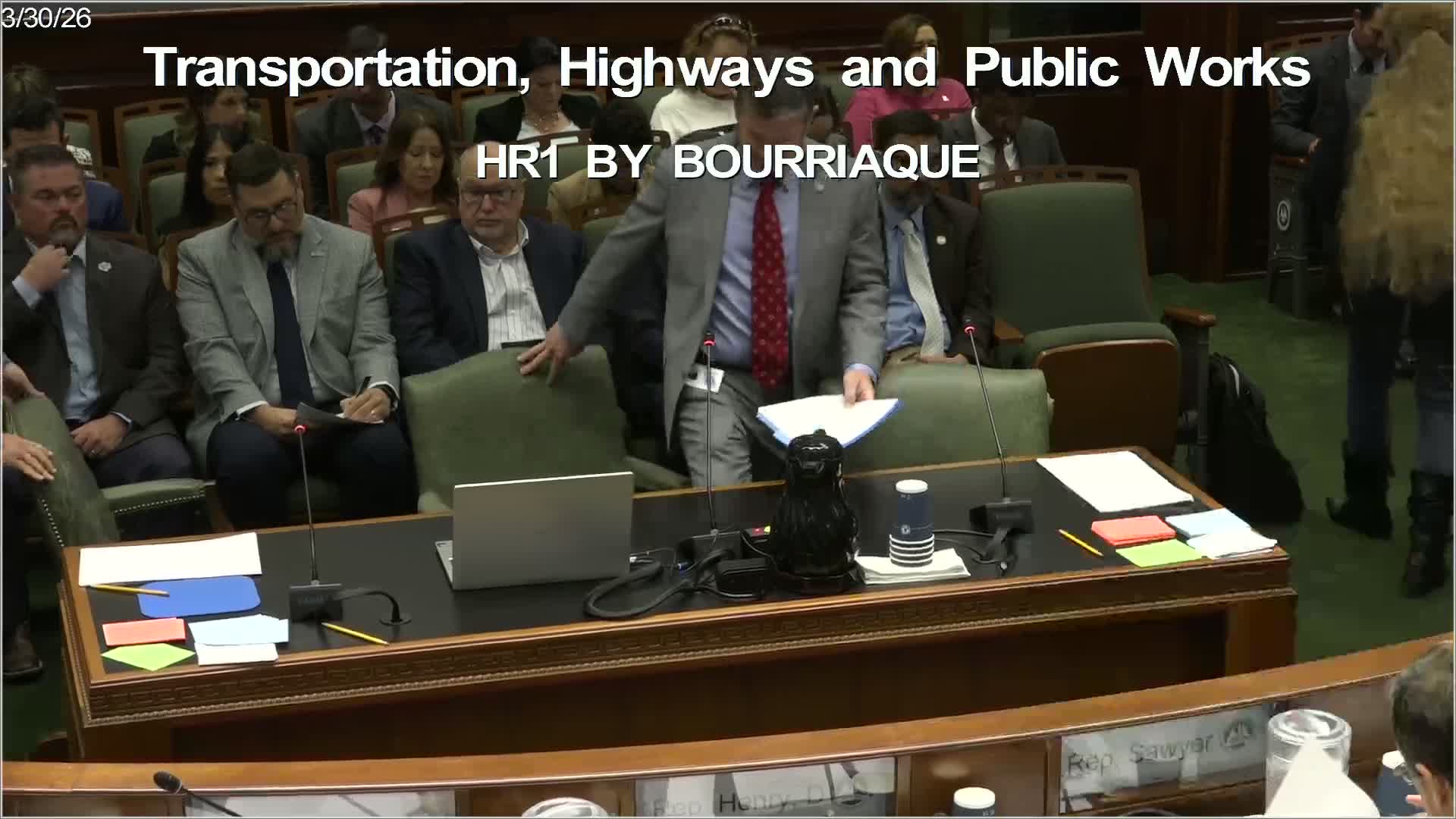
The House Transportation Committee voted to report House Resolution 1 favorably after a detailed presentation by the Coastal Protection and Restoration Authority (CPRA) on its fiscal year 2026-27 annual plan, which authorizes approximately $1.54 billion in spending.
CPRA chair Gordon Dove and Executive Director Michael Haire told the committee the draft plan covers the entire Louisiana coast and is built around three principal funding streams: GOMESA mineral revenue, federal programs such as CWPPRA, and settlement dollars related to Deepwater Horizon litigation. Haire cautioned that some published line items reflect authorization and multi-year budgeting rather than anticipated single-year receipts: “GOMESA, for example, is listed at $408,000,000 by cap, but weare receiving about $160,000,000 a year and have carryforward on active projects,” he said.
The agency said roughly $1.2 billion of the plan is for construction and related implementation activities, with about 93% of plan dollars targeted at engineering, design, construction or operations and maintenance rather than administrative overhead. Haire noted CPRA currently has between $400 million and $500 million in active construction and a comparable amount in projects moving through the pipeline.
Members pressed CPRA on regional priorities and local impacts. Representatives asked about freshwater reintroduction, home-elevation pilot programs, and the Atchafalaya (Chafalaya) master plan. Haire and Dove said CPRA held public hearings, received nearly 300 public comments, and will continue to coordinate with the U.S. Army Corps of Engineers and local levee districts; Haire offered to provide follow-up briefings for members on master-plan sequencing and parish-level project timing.
CPRA highlighted several major projects: a Calcasieu-Sabine hydraulic restoration phase 1 contract (about $130 million) expected to produce thousands of acres of marsh benefit, Morganza-to-the-Gulf implementation as a centerpiece project, and barrier-island work including Grand Isle and Chandeleur Island operations. Dove said CPRA also secured a $75 million FEMA award to rebuild West Belle Headland after storm damage.
The committee read supporting cards from dozens of local officials and advocates and, without objection, reported HR 1 favorably to the full House. CPRA staff said the annual plan functions as a spending authorization and that program-specific timing will be refined as contracts and federal matches are confirmed.
The committee requested additional briefings on master-plan details and assurances that CPRA will follow up with written answers on several parish-level questions.