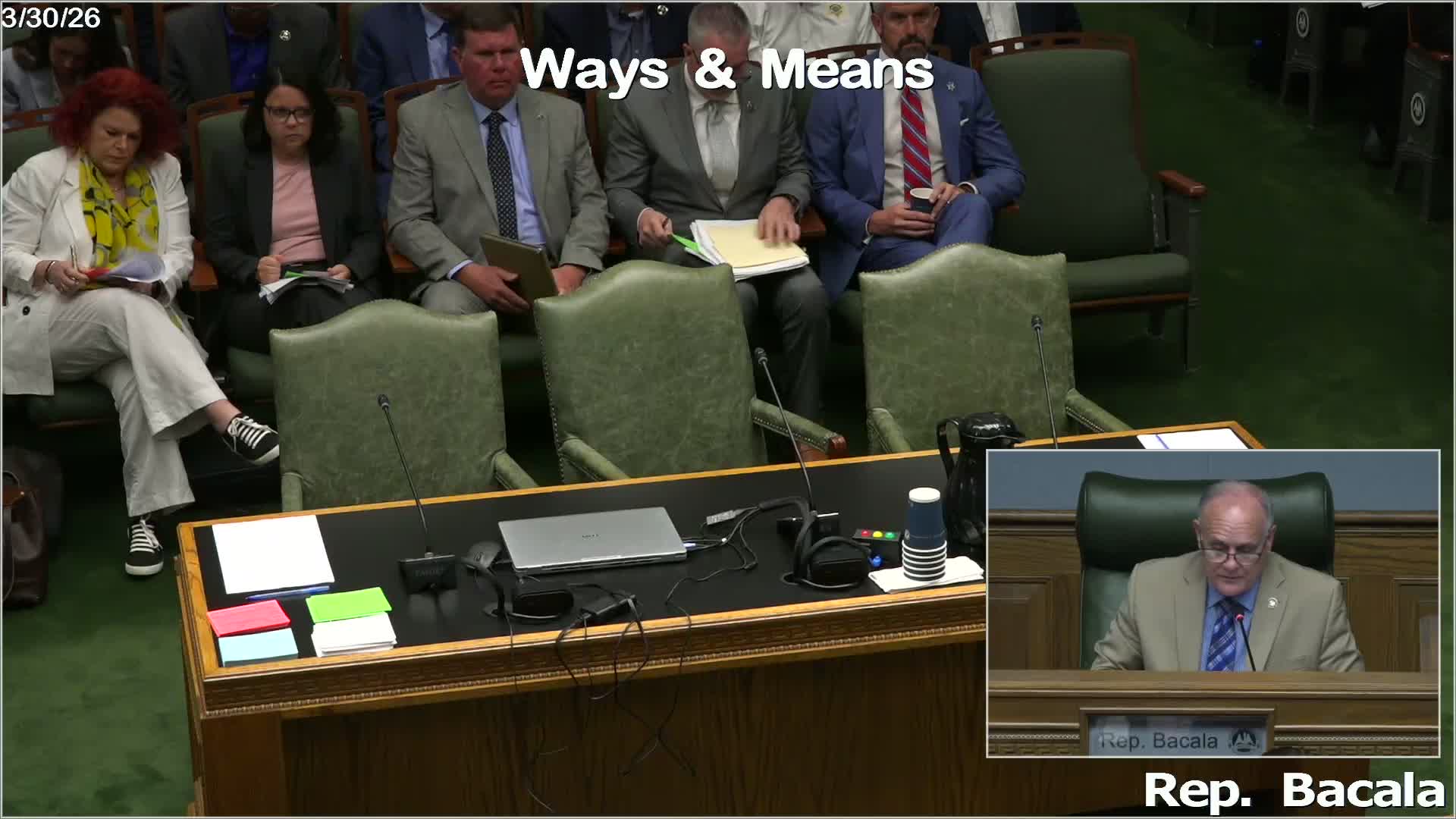
Ways and Means Committee pauses bill to centralize sales tax collection after hours of testimony
Loading...
Summary
Representative Carlson's constitutional amendment to permit centralized collection of state and local sales taxes (HB 620) drew broad testimony from tax experts, business groups and local officials on both benefits and rollout risks. After lengthy questioning and calls for safeguards, the author voluntarily deferred the bill and its companion for further work.
Representative Carlson introduced House Bill 620 as a constitutional amendment to let the legislature provide for centralized collection of all state and local sales and use taxes, arguing it would “increase revenue to our locals without increasing taxes” and reduce compliance costs for in‑state businesses.
"It discourages expansion across parish lines," Carlson said, framing the bill as a way to correct what he described as a two‑tier system that currently advantages out‑of‑state remote sellers. "How long are we going to allow Louisiana to have this decentralized, convoluted, overly burdensome system?"
Experts and business groups told the committee centralization could simplify compliance and recapture uncollected taxes. Manish Bhatt, vice president for state tax policy at the Tax Foundation, said centralization would promote simplicity and lower compliance costs for small and midsize sellers. "Centralization of sales tax collection is sound tax policy," Bhatt said.
Lenore Heavey of the Council On State Taxation (COST) and Leah Long of the National Federation of Independent Business likewise supported the concept, with Heavey urging that central collection would make the system more uniform and transparent and Long telling lawmakers that small, locally based businesses lack the resources to manage dozens of local collectors.
Business groups also stressed harms from the hybrid e‑file rollout earlier this year. Jim Patterson of the Louisiana Association of Business and Industry described the February launch as problematic: "There were businesses that were unable to get into and operate through the system," he said, urging lawmakers not to repeat systems that create more friction for filers.
Committee members pressed the panel on concrete results from the hybrid rollout, asking whether collections in the first months were materially lower or higher than last year. Representative Orgeron and others said they wanted hard numbers; Carlson acknowledged he had not seen reliable collection totals but said there had been a large uptick in calls for support and that the Department of Revenue had advised a later effective date than the bill currently proposes.
Local officials and some lawmakers raised operational and fiscal concerns: several members, noting sheriffs and school boards in their parishes, asked how cash flow would be protected and how local governments would retain audit authority and necessary local knowledge. Representative Lacombe cautioned that any central collector must avoid disrupting revenue remittances to parishes that rely on sales taxes for payroll and services.
After extended questioning and requests from members for more stakeholder work, Carlson offered to seek additional time. "I'd be willing to voluntarily defer the bill so that we can give it a little more time and see how this system plays out," he told the committee. Chairman Bakula moved to accept the author's request; seeing no objection, the committee voluntarily deferred HB 620 and its companion (HB 658) for further work and possible resolution language.
Next steps: the author said he will continue stakeholder meetings with local officials and consider amendments — including timing changes — to address cash‑flow protections, local audit roles and implementation capacity at the Department of Revenue.