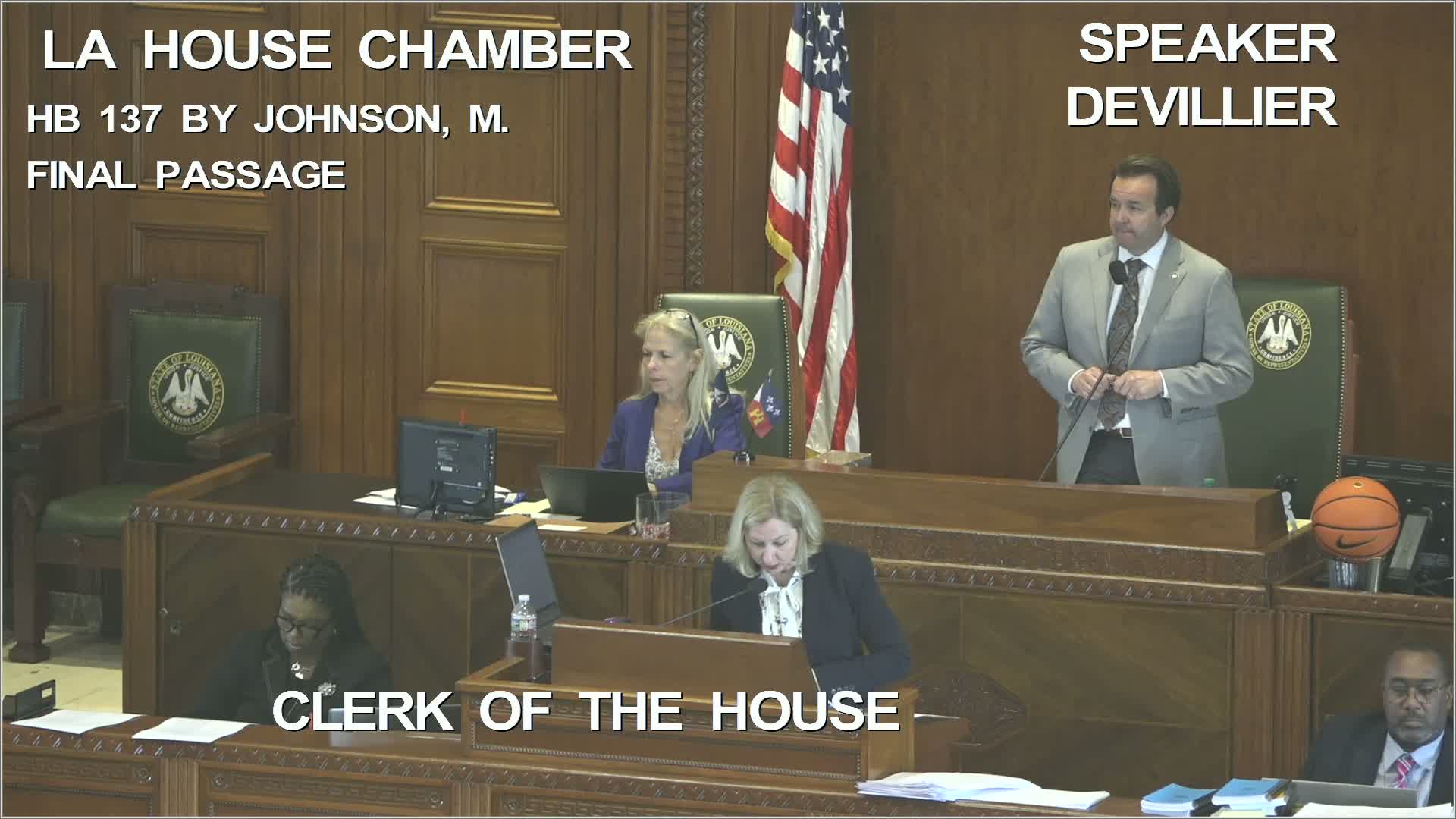
House approves tougher penalties, pilot program for school threats; bill draws questions on parental liability
Loading...
Summary
Speaker Pro Tem Mike Johnson’s bill to strengthen penalties for school threats and set up a youth-intervention pilot passed 71–26 after floor debate. Lawmakers pressed the sponsor on parental liability, funding for interventions, and how courts would apply civil reimbursement for law-enforcement costs.
Speaker Pro Tem Mike Johnson told the House that rising false and terroristic threats against schools have disrupted education and placed heavy burdens on law enforcement, and he framed House Bill 137 as a deterrence tool.
"We have a growing problem in the state," Johnson said on the floor, "...false and terrorizing threats made to our schools." The bill, he said, strengthens criminal penalties in certain cases, adds bomb threats to covered crimes, and directs that schools and parents be informed early in the school year about the consequences of making threats.
HB 137 also authorizes courts to order a mental-health evaluation and to enroll youth in a structured intervention as a primary response; sponsors described the program as a deterrence-first approach rather than a purely punitive one. The measure includes a civil cause of action authorizing parishes or law-enforcement agencies to seek reimbursement for costs incurred responding to severe threats, at the discretion of a judge.
Members questioned how parental liability would function in practice and whether courts would need proof that parents had knowledge of a child’s actions. Representative Mandy Landry pressed whether proof of parental knowledge would be required; Johnson said the provision is designed as a deterrent and that courts would evaluate ability to pay and actual losses. Other members asked who would fund the pilot intervention classes; Johnson said the juvenile or court system would handle treatment decisions and that reimbursement provisions target law-enforcement overtime and extraordinary response costs.
A number of members — including a retired judge who warned of legal precedent — urged caution about shifting civil liability onto parents when a child acts without the parent’s knowledge. Supporters said the law aims for deterrence and education in the early part of the school year, and is targeted at serious threats that impose substantial costs and risks.
Outcome and next steps: The House approved HB 137 on final passage, 71–26. The bill’s pilot elements and civil-reimbursement provisions will require follow-up from the Department of Education and local prosecutors and might prompt implementing guidance or budgetary clarifications as local jurisdictions adapt.