Get Full Government Meeting Transcripts, Videos, & Alerts Forever!
Get email alerts on the Stream Buffer Variance topic
No spam. Unsubscribe anytime.
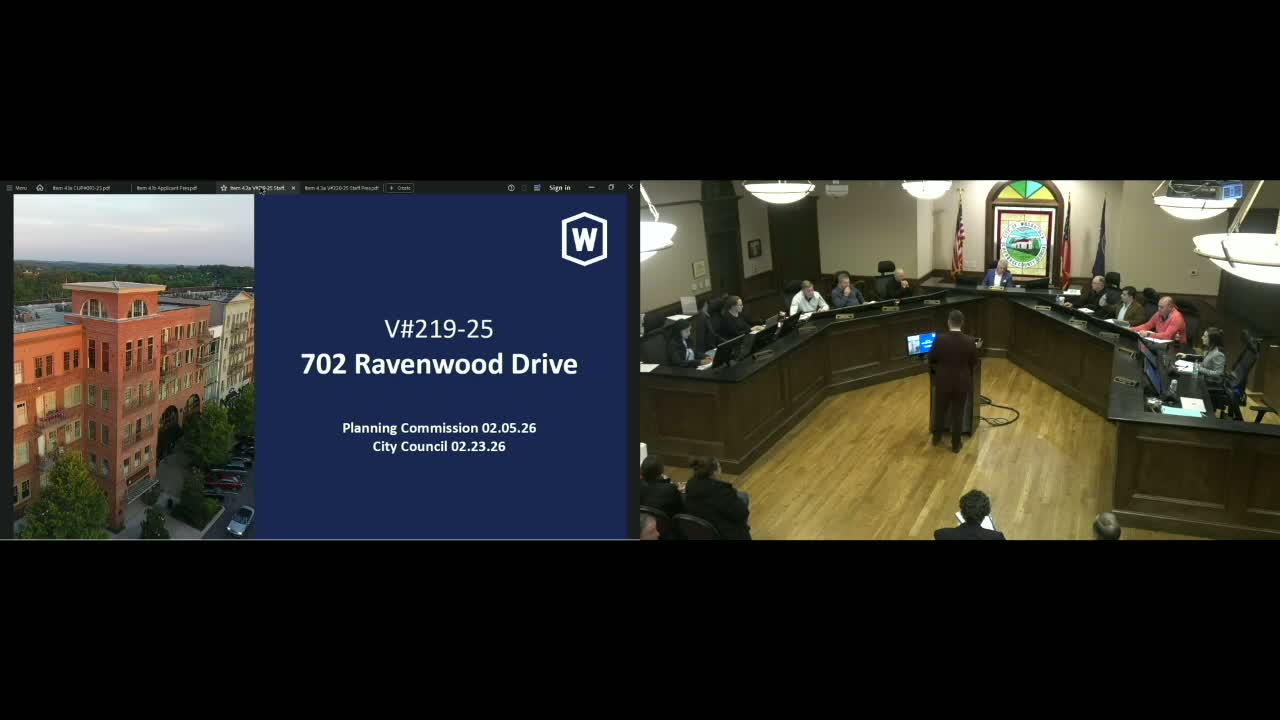
Planning commission approves variance for 702 Ravenwood Drive with conditions amid residents’ environmental concerns
Summary
The commission voted to approve variances allowing limited disturbance of stream buffers and impervious setbacks at 702 Ravenwood Drive, subject to conditions including restricted disturbance, two‑story height limit, architectural review and a construction‑access condition; residents warned of flood and sewer risks.
The Woodstock Planning Commission voted to approve variance requests for 702 Ravenwood Drive, allowing limited grading into the 50‑foot stream buffer and some impervious area within the 75‑foot setback, subject to multiple conditions recommended by staff.
Planning staff described the lot as heavily constrained—about 86% in regulated stream buffers—so the applicant proposed siting a two‑story home on the smallest practical developable area. Cameron Dunn, planning staff, said staff recommended approval with conditions to limit disturbance to the area shown on the site plan, cap height at two stories, require architectural compatibility review and require reconstruction of any public infrastructure damaged during construction.
The applicant’s representative (Parks) and applicant Jeff Smith emphasized that sewer access now makes development possible and that engineering and site‑plan review will be required to meet stormwater and sewer rules. "We will have to comply with all the city development regulations, stormwater, water quality," Parks told the commission.
Opposition speakers raised technical and long‑term environmental concerns. Raven (a resident) cited state buffer‑variance submission requirements and argued the applicant had not provided required environmental surveys, mitigation calculations or a permit from the U.S. Army Corps of Engineers where applicable. Raven warned that boring sewer lines beneath the stream and installing private grinder pumps for sewage posed contamination and long‑term maintenance risks.
Jeff Coleman, a resident who identified himself as a lifelong plumber, said that a sewer line under a creek presents a different failure mode than on‑site septic: "A failure of raw sewage releases immediately into the creek," he told commissioners, arguing that such failures can be hard to detect and can cause extensive downstream impacts.
Commissioners debated engineering tradeoffs and whether the conditions proposed by staff would sufficiently limit impact. Commissioner Greg moved to approve the variances in accordance with staff recommendations; the motion passed with one commissioner recorded in opposition (Commissioner Roth). Commissioners also agreed on a construction‑access condition: use of the gated Ravenwood/Brownlee entrance for construction traffic from issuance of land‑disturbance permits through certificates of occupancy, a condition intended to reduce construction traffic through neighborhood streets.
City staff noted that final site‑plan approval (a separate, later step) must satisfy city and state stormwater and sewer regulations; if engineering submissions fail to meet those standards, staff will not issue site‑plan approval regardless of the commission’s recommendation.
Next steps: the commission’s recommendation and conditions will be forwarded to City Council for final action; a separate site‑plan review will follow if the council approves the variances.