Senator Hester wins series of energy amendment votes to direct PSC review and enable DGS leasing
Loading...
Summary
The Education, Energy, and the Environment Committee approved multiple Senator Hester amendments that (1) substitute technical language for a data-center amendment, (2) require PSC recommendations for the EMPOWER program, (3) add cost-effectiveness tests for residential subprograms and (4) allow DGS to seek long-term leases while conducting its 50-site study.
The Education, Energy, and the Environment Committee approved a package of amendments offered by Senator Hester that update definitions, order reviews of the EMPOWER program, require cost-effectiveness tests for residential programs and allow the Department of General Services (DGS) to issue requests for proposals for long-term leases while conducting its 50-site study.
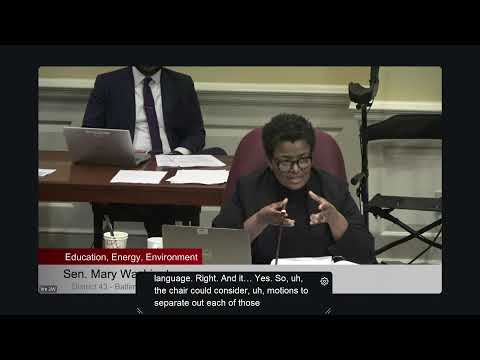
Senator Hester described the substitute amendment as the same text adopted previously but with two technical changes — replacing “district heat systems” with “district energy systems” to reflect heating and cooling roles and clarifying that battery storage should not be captured in the bill’s nonemitting incremental-resources definition. “If we’re going to decrease the goals and then increase the goals again, could you come back with some recommendations for us to consider policy wise so that when we come back here in 2 years and the prices start to go up again, we actually know kind of what we’re talking about,” Hester said, explaining why she asked the Public Service Commission (PSC) to prepare recommendations for the program.
The committee voted by voice/hand count to withdraw the previously adopted amendment and substitute the revised text, and subsequently approved several additional Hester motions. One uncodified amendment directs the PSC to prepare recommendations for changes to the next EMPOWER program cycle — including program goals’ size and scope, restructuring options to avoid electric-system reliability risk and wholesale cost impacts, and methods for selecting programs (such as cost-effectiveness testing). Another amendment requires a cost-effectiveness test for residential-sector subprograms and clarifies how administrative consolidation or streamlined service delivery can factor into that evaluation. The committee also approved language allowing the Strategic Energy Planning Office to study up to five policy scenarios by 12/31/2026, and an amendment clarifying that DGS may issue requests for proposals for long-term leases for new or expanded generation or storage on state-owned sites while conducting its 50-site study.
Staff described the measures as technical fixes and programmatic safeguards intended to preserve flexibility while giving the legislature more data and options before making sweeping changes to program goals. Committee members offered limited questions about scope and timing; none of the Hester amendments were amended on the floor. Each Hester motion was moved, seconded, and carried by the committee during the meeting.
The committee’s action bundles several procedural and policy steps intended to give the PSC and state agencies clearer direction and reporting requirements ahead of future decisions. The sponsor said the goal was to avoid repeatedly changing statutory targets without a fuller administrative review and to allow DGS to move quickly on suitable state sites. The committee paused its business to take up House bill hearings and agreed to resume further votes and remaining amendments afterward.