Get Full Government Meeting Transcripts, Videos, & Alerts Forever!
Get email alerts on the Elder Care Unlicensed Housing topic
No spam. Unsubscribe anytime.
Senate committee advances bill to criminalize unlicensed group homes after prosecutors’ examples
Summary
Senate Bill 46 would create a criminal offense for operating unlicensed group homes and sets graded penalties tied to harm; Attorney General witnesses cited cases of deplorable conditions and benefit diversion. The Judiciary C Committee reported the bill favorably by unanimous consent.
Senator Reese urged the Judiciary C Committee to advance Senate Bill 46, a measure to create the crime of operating an unlicensed group home and to establish penalties that scale with the harm to residents. "This is an instrument to create the crime of operating an unlicensed group home," he said, outlining misdemeanor and felony penalties tied to unsafe conditions and resulting injury or death.
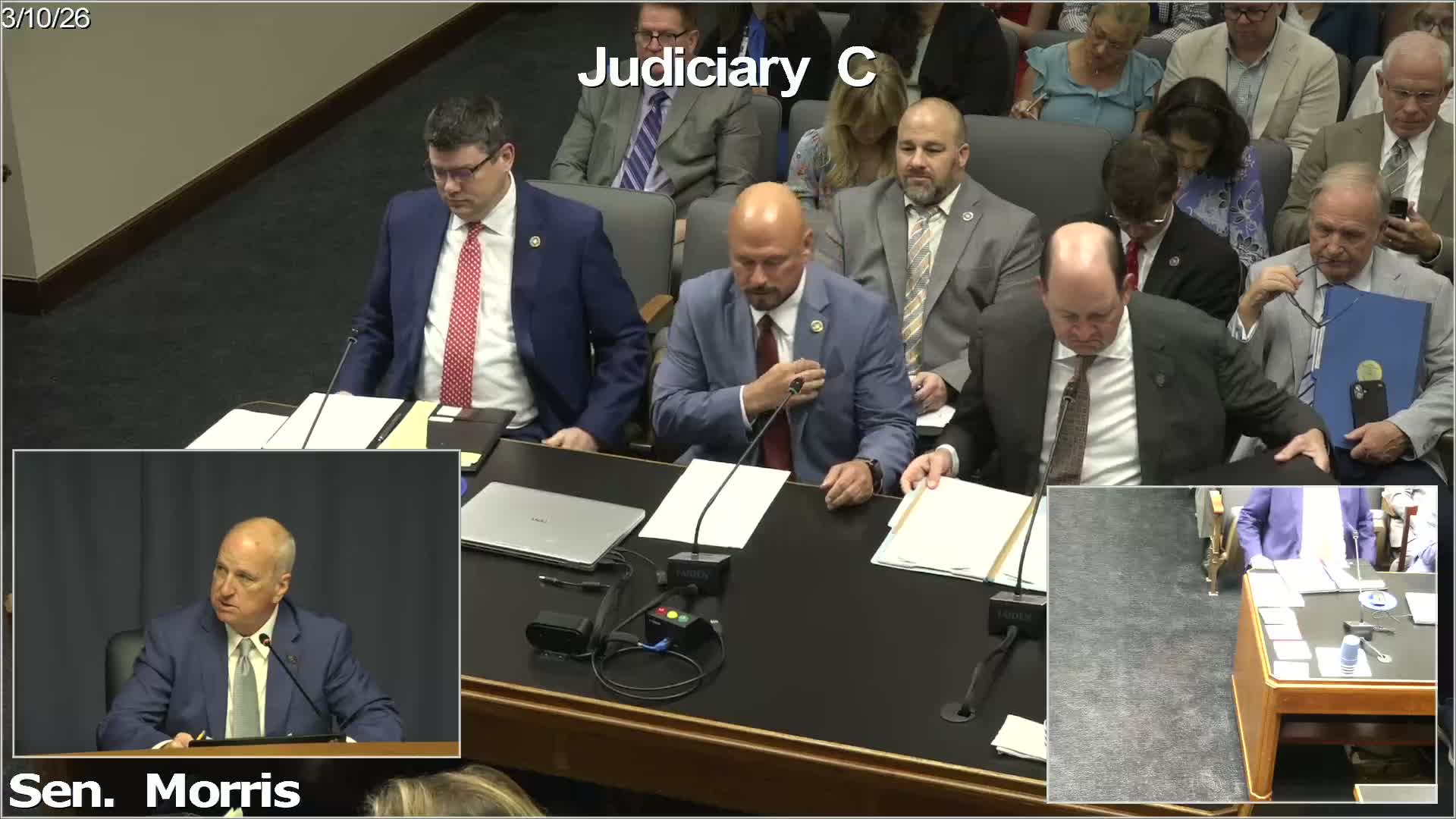
Larry Freeman, chief deputy attorney general, told the panel the bill responds to complaints brought to the Medicaid fraud unit. "We've seen some deplorable conditions," Freeman said, and he introduced the Medicaid fraud control unit director to give examples.
Matthew Stafford, director of the Medicaid Fraud Control Unit at the Attorney General's Office, described housing where "the ceiling's caving in, the floor is rotting out," where some homes "don't even have running water" and residents were using "a bucket in the middle of the room for a toilet." Stafford also cited a case he said involved 15 people living in a three‑bedroom home and accused operators diverting residents' Social Security and other benefits.
The bill sets a tiered penalty scheme: a misdemeanor (up to six months and a $1,000 fine) for unsafe but non‑injurious conditions; a felony (up to 10 years or $10,000 fine) where conditions cause serious suffering; and a higher felony (five to 40 years) where conditions contribute to a resident's death. Support cards were filed by the Louisiana District Attorneys Association and Elderly Protective Services.
Senator Barrow, who said he had seen similar problems in his district, agreed to coauthor. With no objections, "that bill will be reported favorably," the chair announced.
The committee did not take a roll‑call vote; the bill was reported out by unanimous consent. The measure's supporters said it closes a prosecutorial gap for operators of homes that receive Medicaid payments but are not licensed or regulated.