Lifetime Citizen Portal Access — AI Briefings, Alerts & Unlimited Follows
Superintendent defends GATOR rollout; senators flag equity, special‑education and funding gaps in K‑12 budget
Loading...
Summary
State education officials told the Senate Finance Committee that GATOR ESA priorities were set to preserve existing voucher students and that expansions were limited by funding; senators raised concerns about special‑education representation, base MFP funding and child‑care wait lists.
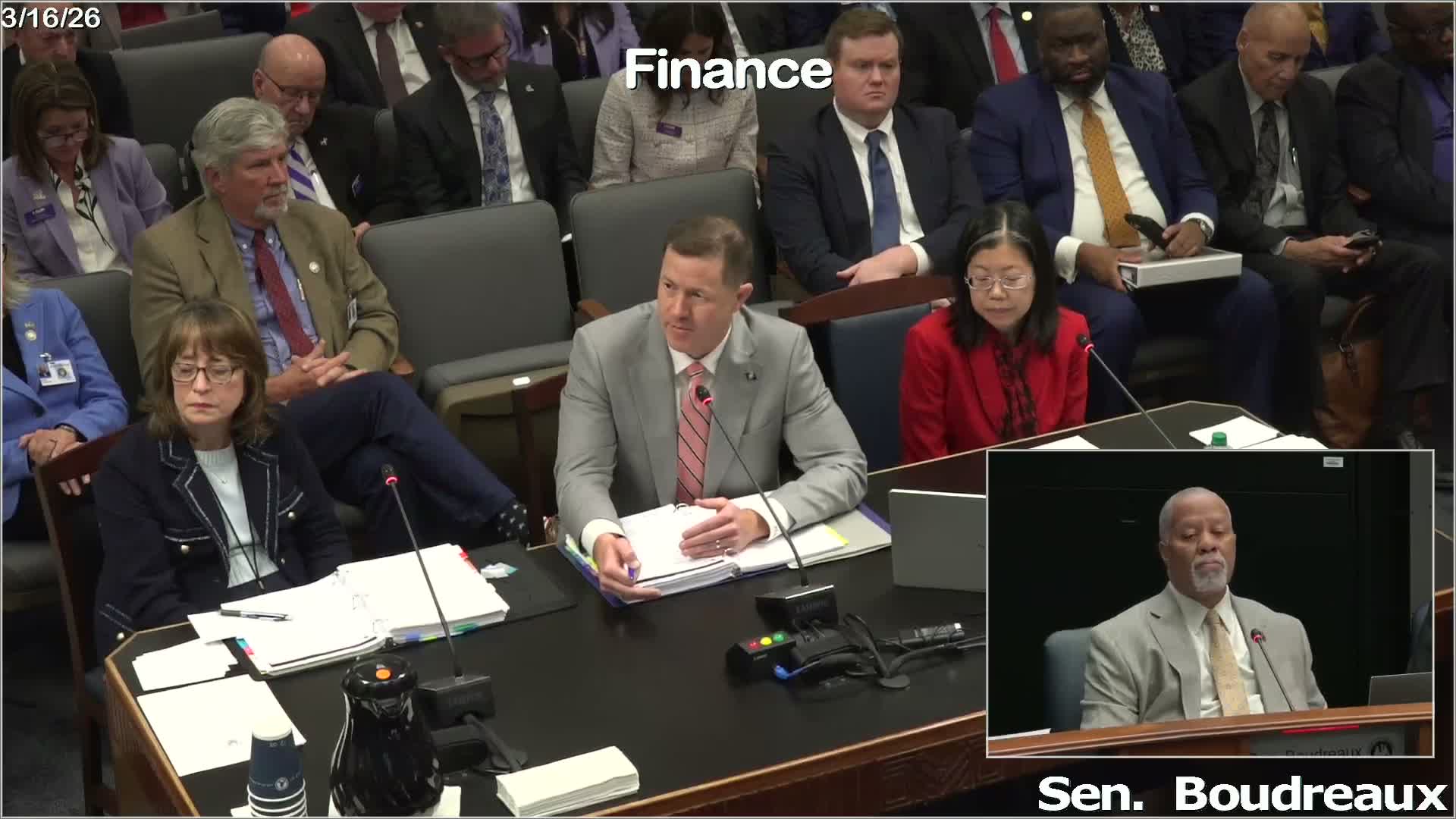
State Superintendent Kate Bromley told the Senate Finance Committee on March 16 that the new LA GATOR education savings account program has been implemented according to the law and BESE priorities and that phase 1 priority 1 included students previously enrolled in the voucher program. "Phase 1 priority 1 was the voucher kids," Bromley said, adding that BESE set priorities that currently list siblings as priority 3.
Bromley and Department of Education staff faced multiple questions from senators about how slots were allocated to new students, the representation of students with disabilities in the initial expansion and comparisons of state per‑pupil spending between public schools and GATOR awards. Senators noted media reporting that a small share of GATOR enrollees are students with disabilities and asked whether the program’s design and implementation will change to increase access for those students; Bromley said new seats were limited by funding and that of the roughly 700 new seats awarded this year approximately 30–40% of those additional seats were for students with disabilities, but that because voucher students represent the large bulk of GATOR enrollments overall the proportion remains small in the aggregate.
On school funding, senators pressed LDOE on the Minimum Foundation Program (MFP). Bromley explained that BSEE submitted the MFP recommendation on March 15, and that the executive budget left base Level 1 (per‑pupil base) unchanged while increasing a Level 3 operational supplement from $100 to $147 per student to reflect inflation in utilities and related costs. "If the legislature does not approve the MFP formula that BESE has submitted, it will equate to a $42,000,000 loss for traditional public and public charter schools," Bromley said. Senators asked about the last base increase (2018‑19) and expressed concern that base funding has not kept pace with inflation.
On early childhood and child‑care funding (CCAP and LA4), LDOE staff said the department serves roughly 57,000 children in publicly funded seats and that CCAP has a waiting list of more than 5,500 families, representing about 7,000 children; staff said federal pandemic funding had temporarily expanded capacity but those federal funds were not permanent and the state is still trying to close the gap.
What happens next: Committee members requested additional analyses from LDOE and BESE staff on MFP choices, demographic impacts of GATOR prioritization and the size and administration of early‑childhood waiting lists. No final appropriations were taken during the hearing.
Attributions: Superintendent Kate Bromley, Mei Hsu (Senate Fiscal Services), BSEE and BESE questions from multiple senators during the March 16 hearing.