Get Full Government Meeting Transcripts, Videos, & Alerts Forever!
Get email alerts on the Preengineered Buildings topic
No spam. Unsubscribe anytime.
LA Unified committee hears pitch to use pre‑engineered building sections to speed school construction and reduce budget uncertainty
Summary
Outside presenters and facilities staff told the Facilities & Procurement Committee that pre‑engineered building "kits" can shorten construction timelines, reduce change orders and lock in costs; members asked staff to study procurement routes — including whether components can be bought via CMAS — and to return with legal and cost analyses.
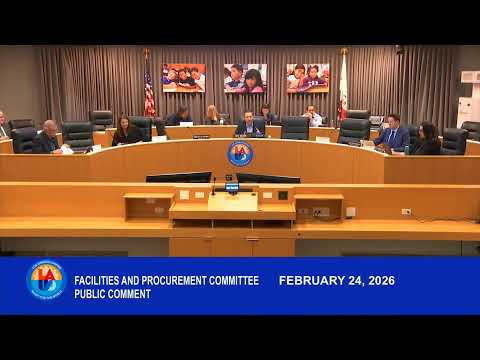
The Facilities & Procurement Committee of the Los Angeles Unified School District on Tuesday, February 24 heard presenters and staff describe how pre‑engineered building sections — a kit‑of‑parts approach — can shorten timelines and improve cost predictability for permanent school buildings.
Jeff (speaker 4), a presenter who works with Cube, said a pre‑engineered section functions like “a kit of parts” delivered and then assembled on site, and that the approach reduces uncertainty because districts can lock in the price of long‑lead items and rely on pre‑certified drawings (PCs). “It gives you a predictable price, the timeline pressure, and the predictability gap needed for a consistent outcome,” Jeff said.
Michelle Fox (speaker 3), introduced by the committee as a K‑12 public‑sector construction consultant, reviewed examples from other California districts. Fullerton used pre‑engineered gyms to show visible progress to voters and repeated that approach at other sites; Downey standardized repeatable kits to stretch bond dollars across multiple campuses; and Temecula replaced a condemned modular building in roughly nine months, a timeline the presenters described as unusually fast but achievable under an accelerated delivery plan.
Why it matters: committee members and staff said predictability and repeatability are pressing concerns for LA Unified, which faces high demand, constrained contractor availability and DSA (Department of the State Architect) review timelines. Committee chair (speaker 1) noted the committee’s priorities to reduce project time and cost escalations and to expand the pool of prequalified bidders.
Questions and follow‑up: board members pressed presenters and staff on procurement pathways and legal constraints. Committee member Steve Newton (speaker 6) asked what is actually delivered in a kit and how site assembly proceeds; Jeff described the package as pre‑approved drawings, structural steel, insulated wall and roof panels and other components that can be purchased in advance to lock price and reduce change orders. David Rodriguez (speaker 7) asked about standard pricing; presenters said there is a stable base price for the main components, but site fit‑outs and finish selections change per project.
Committee members also asked whether the district can use cooperative contracts such as CMAS to buy pre‑engineered components. Friedman (speaker 8), representing district procurement staff who have advised on precedent, said the district has previously taken the position that piggybacking or contracting that includes installation labor on fixed foundations raises legal and public‑contract code issues. Mark Miller (speaker 9) said he would follow up to review whether components only (no installation labor) can be purchased under CMAS or other cooperative schedules.
What the committee asked staff to do: members requested a written follow‑up on the legal analysis and a cost comparison of procurement routes (CMAS/components purchase vs. going to market), plus examples of vendor markups and whether the district should buy components directly to avoid those markups.
Next steps: staff and presenters said they will provide follow‑up information to the committee about procurement options and examples of districts that have used component purchases or cooperative contracts. The presenters and staff emphasized that pre‑engineered sections are one tool in a broader procurement toolbox — not a universal solution for every site.