Get Full Government Meeting Transcripts, Videos, & Alerts Forever!
Get email alerts on the Police Accountability topic
No spam. Unsubscribe anytime.
Urbana residents press council after use-of-force report, demand plan for accountability
Summary
Speakers at the Committee of the Whole urged the Urbana City Council to explain how recent investments in policing will reduce disproportionate use of force against Black residents and to shift funding to social services and alternative response programs.
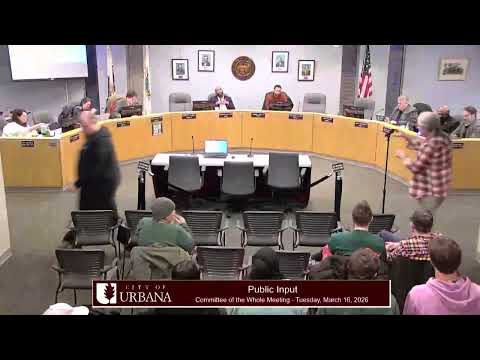
Public commenters at Urbana’s Committee of the Whole on March 16 told the mayor and council they were alarmed by a city use-of-force report and demanded concrete steps to reduce racial disparities and redirect funding.
Jessica Yacine, speaking for the CU Muslim Action Committee, told the council that Black residents make up roughly 19% of Urbana’s population but, based on the recently released report, bore about 78–81% of recorded police-force incidents. “Let that sink in,” Yacine said. “That means that in 1 year, effectively, every single Black person in this community statistically had force used on them by police.” She said the council must present “a plan” showing how recent investments in police recruitment and compensation will produce improved outcomes.
Steven Maguire criticized leadership decisions and cited specific personnel actions, saying those choices help explain the city’s use-of-force trends. “If you want to know why we have these numbers, that could be why,” Maguire told the committee, referencing a promotion he said raised community concerns. He also called attention to a recent grocery tax that generated about $1,000,000 in revenue and said roughly 60% of that is being directed to police budgets — money he argued could fund housing, food banks and shelters.
Other speakers made similar points. Stuart Levy and Luke Lee described longstanding patterns of racially disparate stops and enforcement, urging the council to examine structural causes beyond economic maps. Gabriel Dunn, who identified himself as experiencing homelessness, warned that services are currently allocated in ways that leave some low-income residents without needed support.
The committee did not take an immediate policy vote on policing, but the public input set a clear demand for a council response. The meeting proceeded to a staff presentation and a lengthy discussion of a separate surveillance-technology ordinance; the committee moved several agenda items to the full City Council for final action.