Lifetime Citizen Portal Access — AI Briefings, Alerts & Unlimited Follows
Baltimore committee pauses bill to close trailer parking loophole, seeks clearer fines and enforcement
Loading...
Summary
The Land Use and Transportation Committee reviewed Council Bill 26-145 on March 19, 2026, which would expand the city's definition of commercial vehicles to include trailers whether hitched or not, adopt FHWA vehicle-class visual standards, and tighten overnight parking enforcement; the committee recessed the measure for further drafting and scheduled a follow-up for March 26.
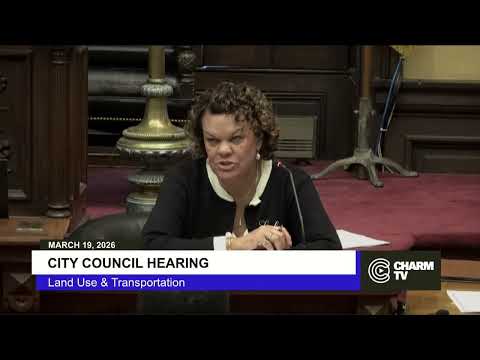
Baltimore City Council Land Use and Transportation Committee Chair Ryan Dorsey, the bill's sponsor, introduced Council Bill 26-145 on March 19 in the Clarence Duburns City Council Chamber, saying the ordinance is designed to close a longstanding loophole that lets trailers avoid enforcement when they are attached to passenger vehicles.
"It just seems nonsensical that this thing that is illegal to be parked on the street suddenly becomes legal to be parked on the street if it's touching another thing," Dorsey said, describing instances where trailers hitched to pickups or small cars currently escape enforcement.
The ordinance would amend city code to use Federal Highway Administration (FHWA) gross vehicle weight rating categories (for example, category 3 through category 6) so officers can visually identify commercial vehicles without needing to weigh them. Dorsey said the FHWA chart is included in the committee packet to aid enforcement officers.
The bill also seeks to make explicit that commercial vehicles may not be parked on any city street overnight (the committee discussed enforcement in the 1 a.m.–7 a.m. window) and would treat trailers the same whether they are hitched or unhitched. Dorsey noted three packet amendments: an exemption for small trailers used to carry disability equipment when attached to vehicles with handicap placards; a clarification of the "imminent loading/unloading" exception for deliveries; and a technical cleanup removing superfluous language.
Agency representatives at the hearing generally backed the measure. Desiree Lecke of the Law Department told the committee the bill is approved "for form and legal sufficiency" including the proposed amendments. Gabriel Stewart Sikowitz, legislative liaison for the Department of Finance, said Finance supports the change to FHWA categories because it helps make enforcement more consistent, even as officials acknowledged the quality-of-life benefits are difficult to quantify.
The Baltimore Police Department and the Parking Authority submitted favorable reports, and Vanessa Frein, deputy director for the Mayor's Office of Small Minority Business Advocacy and Development (SIMBAD), said her office's report supports the legislation.
Councilmembers pressed agencies on enforcement logistics and penalties. Councilmember Paris Grama described neighborhood streets blocked by multiple unhitched trailers, a multiwide trailer and a semi, and asked whether DOT has towing capacity to remove illegally stored trailers once the ordinance is in effect. Luciano Diaz of the Department of Transportation said the city can double down on enforcement but must follow state law when a trailer lacks registration: "Under the state transportation article section 25-201b, abandoned trailers are considered inoperable if they do not have a license plate, and we can remove them after 48 hours," he said, adding that if an owner moves the trailer within that window the removal process must restart.
Committee members also focused on the fines schedule. Dorsey said the current draft contains inconsistent fine levels (for example, a $250 citation for some daytime stopping violations but a $75 penalty referenced for overnight parking in another line), and asked staff to help clean the language so penalties align with enforcement goals. Councilwoman Sharon Green Middleton and others urged raising fines to increase deterrence; Dorsey said he would work with staff to draft clearer, more consistent penalty language.
Members raised smaller practical questions: whether roof or ladder racks and commercial lettering would trigger a commercial classification (Dorsey said body category and state definitions matter), and whether parking enforcement practices such as chalking tires could be changed to make it harder for owners to simply move trailers after a chalk mark appears. Grama asked DOT to consider chalking a less visible wheel; DOT agreed to investigate and report back within two weeks.
Dorsey requested that DOT, the Baltimore Police Department and Finance be prepared at the committee's next meeting to report on readiness to implement the ordinance within the 30-day enactment window, including updates to handheld citation devices. The committee recessed debate on Bill 26-145 for further drafting and one-on-one discussions with members; the chair added the item to the March 26, 2026 agenda for additional review.
What's next: The committee did not take a final vote. Staff will revise fine language, DOT will study enforcement tactics and equipment readiness (including a request to BCIT to update handheld citation categories), and the committee will revisit the bill at its March 26 meeting.