Senate committee advances Oklahoma general appropriations bill after hours of questioning; 18-5 vote
Loading...
Summary
The Senate Appropriations Committee advanced Senate Bill 1177, the state general appropriations bill, following extensive questioning about cash sweeps, ARPA interest for water loans, education pay raises, mental-health funding and several agency line items. The committee approved the bill 18-5 and sent it forward to the Senate.
Senator Hall, chairing the bill presentation, told the Senate Appropriations Committee that Senate Bill 1177 presents a balanced budget and asked members for their questions before the committee voted to advance the measure.
The bill relies on a mix of one-time and recurring cash resources, Hall said, including unclaimed property, insurance-commissioner receipts, funds from the secretary of state, FMAP preservation, opioid-abatement funds and the revenue stabilization fund. "We're pulling from a lot of cash resources that have been traditional sweeps for us," Hall said, and added the budget uses some unused FY25 and FY26 general revenue cash.
Members pressed Hall on several high-profile items. On ARPA-related funds, Hall said the bill sets aside $35 million to create a revolving loan fund administered by the Oklahoma Water Resources Board using ARPA interest earned over prior years. On the revenue stabilization fund, Hall described a plan in the budget agreement to lock roughly $200 million into a long-term "taxpayer endowment" for about 10 years or until the fund reaches $1 billion, saying the goal is to help future legislatures manage unforeseen financial needs.
Education provisions drew sustained scrutiny. Hall confirmed the budget includes "just a little south of a $100,000,000" for the state funding formula and that a $2,000 teacher pay increase included in the package would affect roughly 43,000 certified personnel and teachers. "You can find that in section 22 of the bill," Hall said. Members asked whether districts would have discretion; Hall said yes, districts choose how to spend those dollars.
On mental health, Hall told the committee the budget contains roughly $135 million in new funding for the Department of Mental Health, including resources aimed at satisfying the state's consent-decree obligations. Hall also said the move to privatize some Certified Community Behavioral Health Clinics (CCBHCs) is expected to reduce salary costs and produce an estimated $10 million in savings; several senators pressed him on whether privatization would preserve service capacity and whether the savings estimate was supported by procurement results. "The RFP has gone out," Hall said, and officials estimate savings from no longer paying those agency salaries.
Other line items noted during questioning included an $18 million sheriff assistance revolving fund to provide equipment grants to counties; $3 million for a civics institute to the University of Oklahoma passed through UHAT; $3 million for Langston University extension services in the Department of Agriculture pot; a $2 million biosolids pilot to test land-application materials (using leftover FY25 cash); and appropriations for reading programs including Imagination Library and a new private curriculum provider listed as Just Right Reader.
Senators debated the bill's priorities in closing remarks. Senator Kurtz criticized the late release of the bill and said some priorities appear skewed toward special projects rather than broad investments in childcare and workforce development. Senator Hall defended the package as balanced and highlighted that "82% of the new spending in this budget is water, education, and health care," adding that the proposal meets the Legislature's constitutional duty to present a balanced budget.
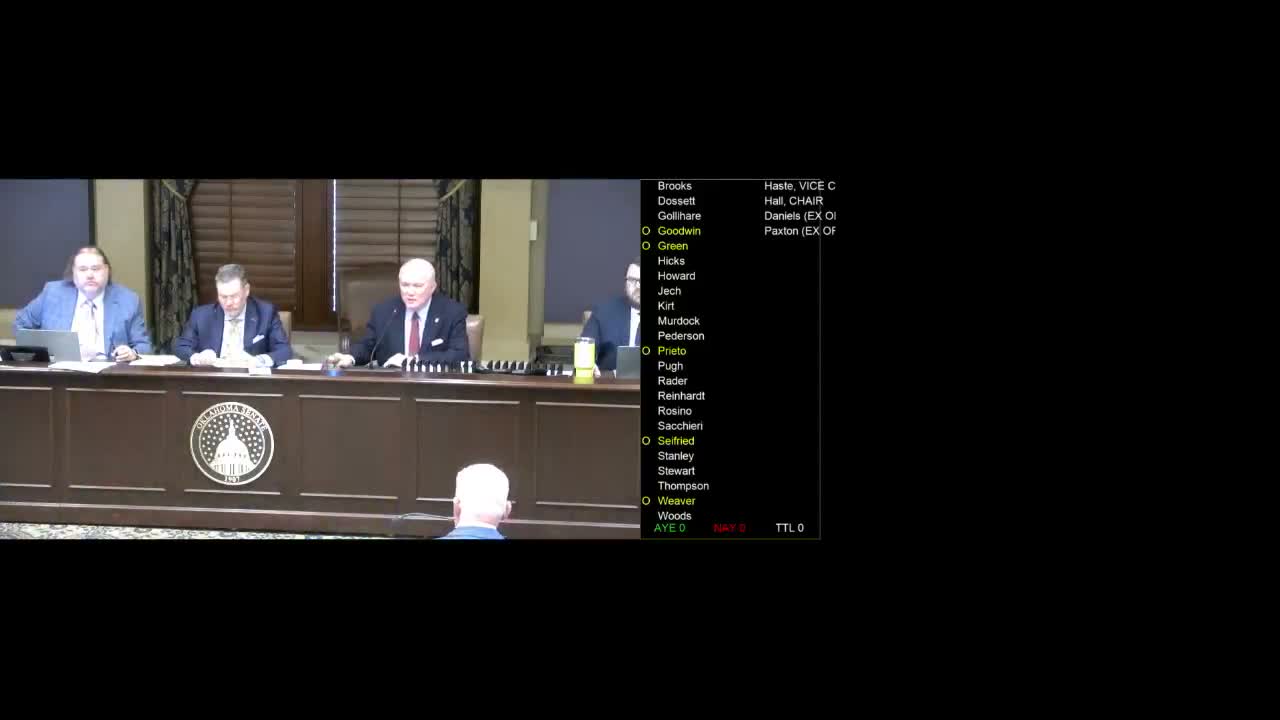
The committee moved the bill "due passed" from the committee, with Senator Hall recorded as mover and Senator Howard as the second. A roll call later recorded 18 ayes and 5 nays, and the chair declared Senate Bill 1177 passed by the committee. The meeting adjourned with Hall saying staff and subcommittees would continue to provide details as the bill moves forward.
Next steps: the bill proceeds to the full Senate for further consideration and potential floor action.