Senate panel approves ad valorem reimbursement change and a trigger resolution tied to Medicaid bill
Loading...
Summary
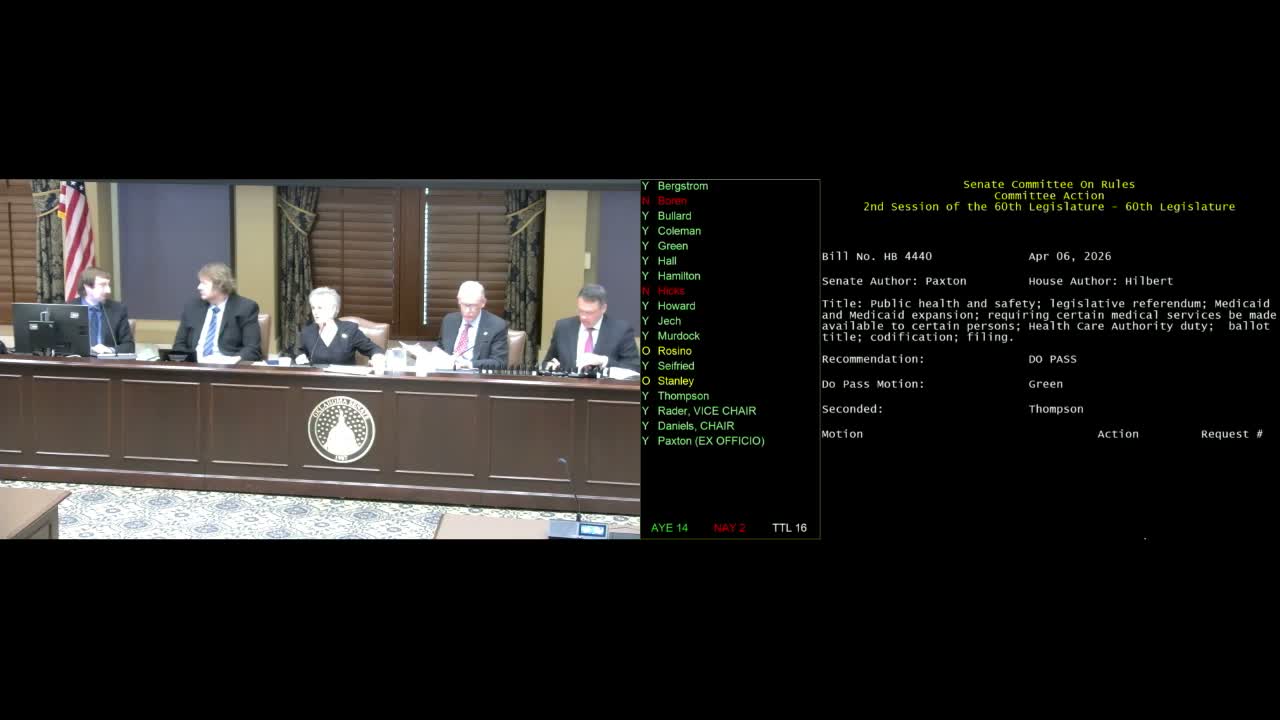
The Rules Committee approved a committee substitute for HJR 1087 on ad valorem reimbursement and passed HJR 10-67, a trigger resolution that would go on November's ballot only if House Bill 4,440 fails in August; both measures passed committee on recorded votes reported as 14–2.
The Senate Rules Committee approved two state-question measures related to tax incentives and contingency planning for Medicaid expansion.
Pro Tem Paxton and other senators presented House Joint Resolution 1087, which would alter the ad valorem (property tax) reimbursement program for qualifying businesses. Presenters said the committee substitute preserves the existing 'shall' requirement for reimbursement while allowing the legislature, should the matter move into statute, to set levels and methodologies for funding.
The committee voted to adopt the committee substitute for HJR 1087 and recorded the vote as 14 ayes and 2 nays.
Senator Daniels then presented House Joint Resolution 10-67, described as a trigger resolution that would appear on the November ballot only if House Bill 4,440 fails in August. The resolution would make the state's obligation to expand Medicaid contingent on the federal match remaining at or above 90%; if the federal match fell below that threshold the constitutional obligation to expand would cease to have effect, giving the legislature flexibility to respond.
Committee members debated the trigger level and whether 90% was the appropriate threshold; Senator Boren suggested a lower threshold would avoid unnecessary structural changes if federal matching slipped slightly. After debate and consideration of an amendment (which was tabled by roll call), the committee passed the committee substitute for HJR 10-67, with the chair announcing a recorded vote of 14 ayes and 2 nays.
Both state-question measures were advanced out of committee for further consideration.