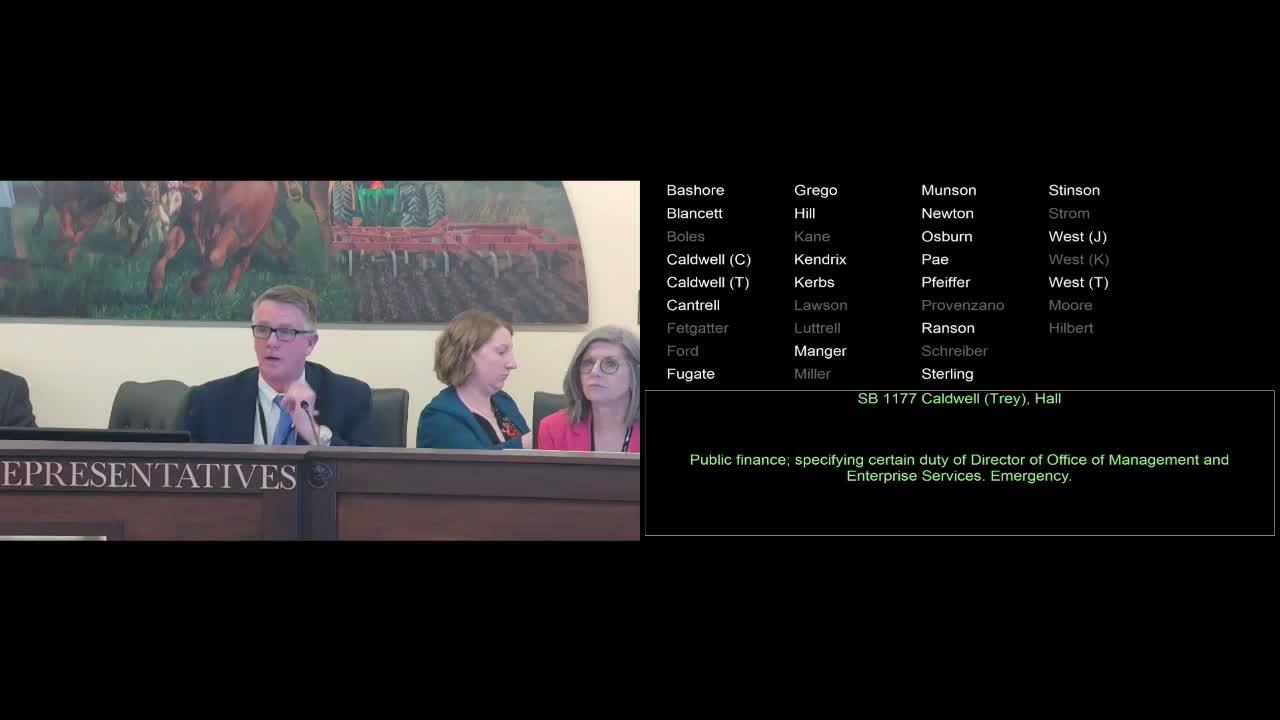
Appropriations committee advances Senate Bill 1177, baselines school safety and moves $200M to a taxpayer endowment
Loading...
Summary
The Joint Appropriations and Budget Committee passed Senate Bill 1177 after extended questioning about childcare, Medicaid, teacher pay, a $3 million DOT aviation purchase and a $200 million statutory 'taxpayer endowment' fund; the vote was 25–5.
The Joint Appropriations and Budget Committee (JCAB) voted to pass Senate Bill 1177, the bill that funds state government, after a day of detailed questioning about line items ranging from childcare to mental-health spending and a proposed statutory taxpayer endowment.
Appropriations Chairman Caldwell presented the bill and urged its passage. During floor questioning, Representative Branson asked whether CareerTech and childcare received sufficient new funding. Caldwell said CareerTech received targeted increases for FBA and educator compensation and disputed the suggestion that childcare received no new funding: "I categorically refute the phrasing of your question," he said, adding that the package increases top-line childcare funding by about $7,800,000 and includes other line items and supplements that together approach $12,000,000 more than last year.
Branson pressed whether the funding would keep providers from closing; Caldwell acknowledged some providers cited a lost $50 million federal subsidy but argued that the per-child loss represented a small share of operating revenue and said he did not expect universal closures.
The committee also discussed a $3,000,000 line tied to the Department of Transportation for aviation asset restructuring at the governor's request. Caldwell said the state currently holds multiple aircraft and described a plan to sell an older DOT plane and use proceeds, in partnership with the Oklahoma Banking Commission, to acquire a more modern, multi-user aircraft.
Representative Boles asked about school safety funding and teacher raises. Caldwell said a three-year SRO pilot has been baselined at $50,000,000 and that the budget includes roughly $111–$112 million for education pay increases, including a $2,000 raise to the statewide teacher minimum.
On public-safety revenue, Representative Fugate questioned whether payments tied to ICE 287(g) agreements (reports cited roughly $7 million received and about $38 million pending) had been incorporated. Caldwell described those receipts as contract-based pass-through funds and said the budget does not currently allocate or sweep those resources; he estimated the Department of Corrections’ share acting as a pass-through would be on the order of $8–$10 million.
Higher-education questions focused on a $3,000,000 line for an OU civics institute and a $2,000,000 sweep from the University Hospital Authority (UHAT). Caldwell said the $3,000,000 comes from the general appropriations and that the UHAT sweep is part of a broader funding arrangement between the University of Oklahoma and Oklahoma State University tied to several capital projects.
Lawmakers also examined a proposed statutory taxpayer endowment (House bill 4072) that would transfer $200,000,000 from the Revenue Stabilization Fund into a newly created investment vehicle. Caldwell described the proposal as a statutory (not constitutional) sovereign-wealth-style fund with a 10-year investment window intended to seek long-term returns; he said converting it to a constitutional fund would require separate action.
Representative Schreiber questioned Medicaid funding after the Health Care Authority requested roughly $494,000,000 more than the previous year; Caldwell said the committee settled on about $250,000,000 in additional state appropriations and that federal match and other pull-downs would increase total Medicaid spending by roughly $1.3 billion next year. He warned that the actuaries’ detailed data had not yet been received and that a supplemental appropriation might be required if utilization trends exceed projections.
Department of Mental Health funding, privatization of some state-run behavioral-health facilities and transition costs were also debated. Caldwell said DMH requests shifted multiple times during the session and described a combination of base increases and several supplemental packages (including amounts referenced in committee discussion). He said privatizing some facilities could yield per-instance savings and that the budget includes a one-time $2,000,000 add-back for transition costs.
After debate closed, a motion to pass the bill was called and staff opened the vote. The committee recorded a roll call and Chairman Caldwell declared Senate Bill 1177 passed by a vote of 25 ayes and 5 nays. Caldwell thanked members and adjourned the meeting.
What happens next: The committee’s action advances the budget package within the legislative process; some items (notably Medicaid funding and the sovereign-wealth statutory structure) may require future adjustments depending on actuarial results, legal drafting and later floor action.