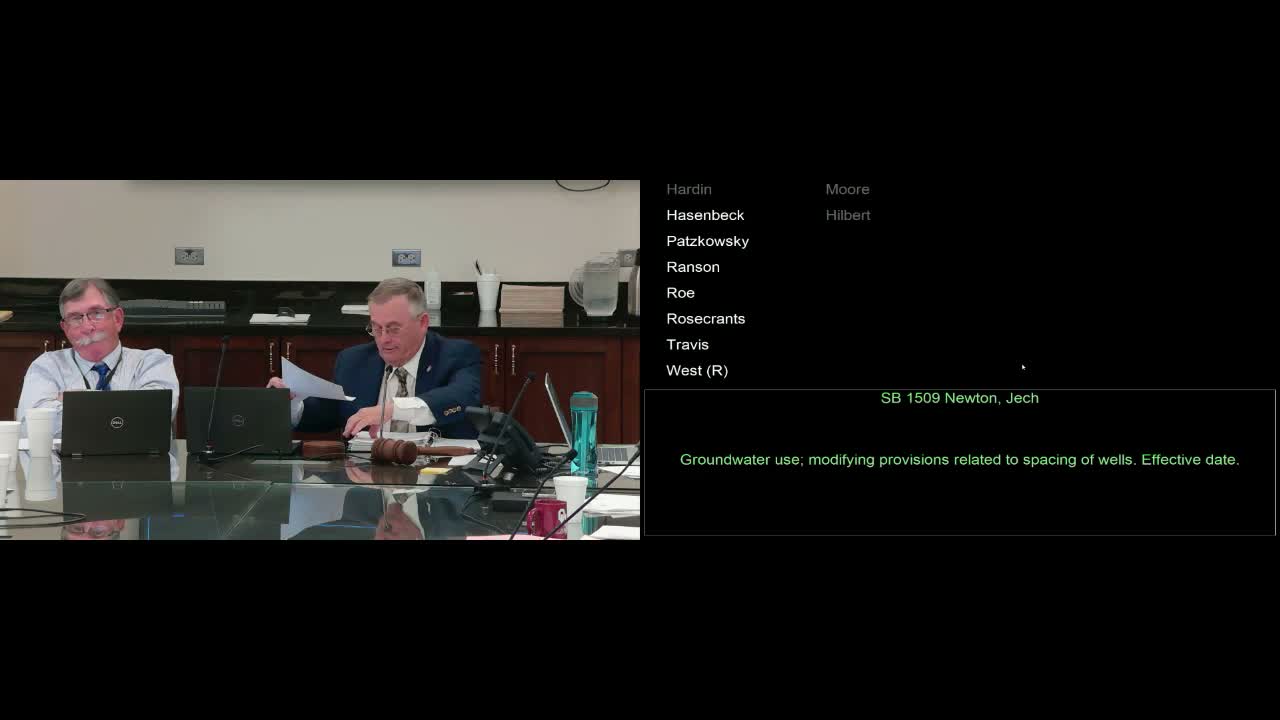
Committee standardizes well-spacing rules, removing requirement tied to maximum-yield hearings
Loading...
Summary
The committee passed SB 1509 to make well-spacing standards uniform across aquifers and remove the requirement that spacing depend on completed maximum annual yield hearings; OWRB representatives said the rule applies to permitted (commercial) wells and exemptions exist to protect landowners.
The House Agriculture Committee approved SB 1509 to standardize well-spacing rules across Oklahoma’s aquifers, eliminating language that tied spacing to the completion of formal maximum annual yield studies.
Representative Newton told the committee that aquifers vary in depth and response and that spacing set by maximum yield studies can differ by area. “That’s why they're wanting to separate it out by the aquifer,” he said, explaining the intent is to make spacing standards uniform rather than dependent on whether a federal- or partner-funded survey has been completed.
OWRB technical answer: Andrew Price of the Oklahoma Water Resources Board told the committee that existing exemptions and rules remain in place so landowners would not be prevented from accessing water beneath their land; the rule applies only to permitted (generally commercial) wells and would not be used for domestic wells, Price said.
Members raised concerns about whether an adjacent landowner could be blocked from drilling a well because of coning effects from a nearby permitted well and asked whether public hearings tied to maximum annual yield determinations were being removed. Price said the bill would allow uniform spacing without requiring the lengthy, costly maximum-yield hearing process while leaving the agency able to complete those studies over time.
Outcome: The committee voted 6 ayes and 3 nays and declared the bill passed the committee.
Provenance: The record includes the bill explanation, Andrew Price’s technical remarks and the committee vote.