Lifetime Citizen Portal Access — AI Briefings, Alerts & Unlimited Follows
Collegedale commissioners weigh formal public-comment rules; agree in principle on sign-ups and a three-minute limit
Loading...
Summary
After reviewing state law requiring a public-comment period, the commission discussed a proposed sign-up sheet, limits on speaker counts and time, a visible timer and protections for public hearings; commissioners agreed to a three-minute guideline with flexibility for the presiding officer.
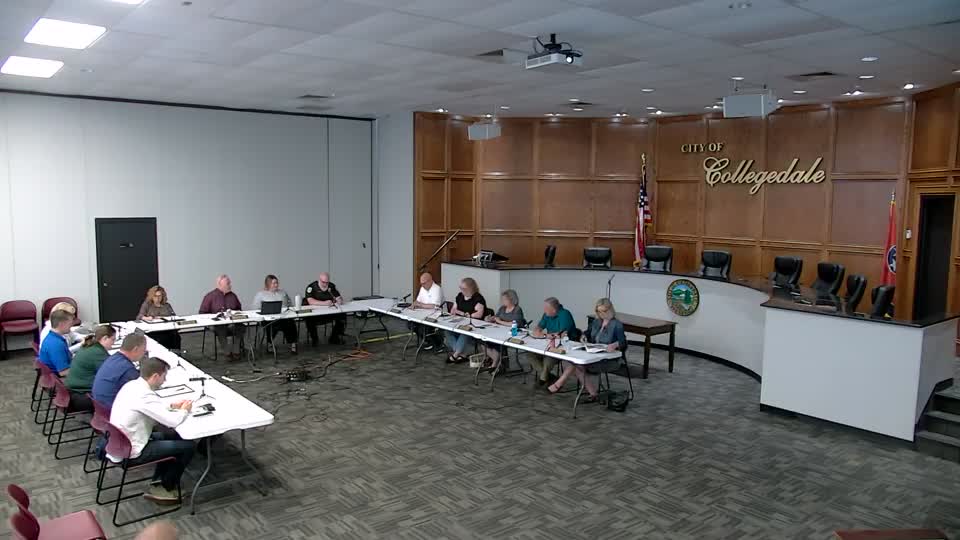
The Collegedale City Commission spent the bulk of its workshop debating how to formalize public-comment procedures and recordkeeping to make meetings more orderly and to protect residents' opportunities to speak.
The mayor opened the discussion by citing the state law he read from the packet, saying the statute requires governing bodies to reserve a public-comment period "to provide the public with the opportunity to comment on matters that are germane to the items on the agenda." He emphasized transparency and the need to create a formal record of decisions.
Staff proposed a practical sign-up process so the city recorder can capture names and addresses for minutes and follow-up. "This gives her the opportunity to make sure that she has names right," the mayor said while presenting a sample sign-up form staff recommended be available before meetings.
The draft guidelines discussed by commissioners included limiting the aggregate number of general commenters to 10 at the start of a meeting, limiting comments tied to an actionable agenda item to 10 total, and placing a per-speaker time limit. Commissioners debated how those limits should interact with formal public hearings: several cautioned that public hearings are distinct and should not be unduly restricted. One commissioner said, "I don't think you should limit the number of people that could speak during a public hearing," and others suggested clarifying the difference between general public comment and a public hearing on an ordinance.
On the amount of time allowed, the commission settled on three minutes per speaker for general comments, with the presiding officer able to grant exceptions. "We've followed this historically ... we did limit people to 3 minutes versus 5 minutes," one commissioner said during the discussion. Commissioners and staff also favored a visible countdown (green/yellow/red light or on-screen timer) to make enforcement consistent; staff offered to manage the clock and record times.
Bridget, reporting on state activity, noted that SB 178 "has been passed and sent to the governor," and that the bill would guarantee comments on agenda topics; she described the city's draft approach as already largely consistent with that measure.
The mayor said the staff will tweak the draft rules, circulate them for commissioner feedback and return a resolution for formal consideration. He also cautioned that disruptive behavior (personal attacks, profanity or staged actions) will not be tolerated.
What happens next: Staff will revise the draft rules based on commissioner feedback, circulate the revised language to commissioners and return a resolution for formal adoption at a future meeting. The commission agreed in principle to a sign-up process, three-minute general comments and a visible timing system but left details and formal adoption to a future agenda.