Get Full Government Meeting Transcripts, Videos, & Alerts Forever!
Get email alerts on the Economic Development topic
No spam. Unsubscribe anytime.
Consultant: Retail recruitment showing early traction after ICSC contacts
Summary
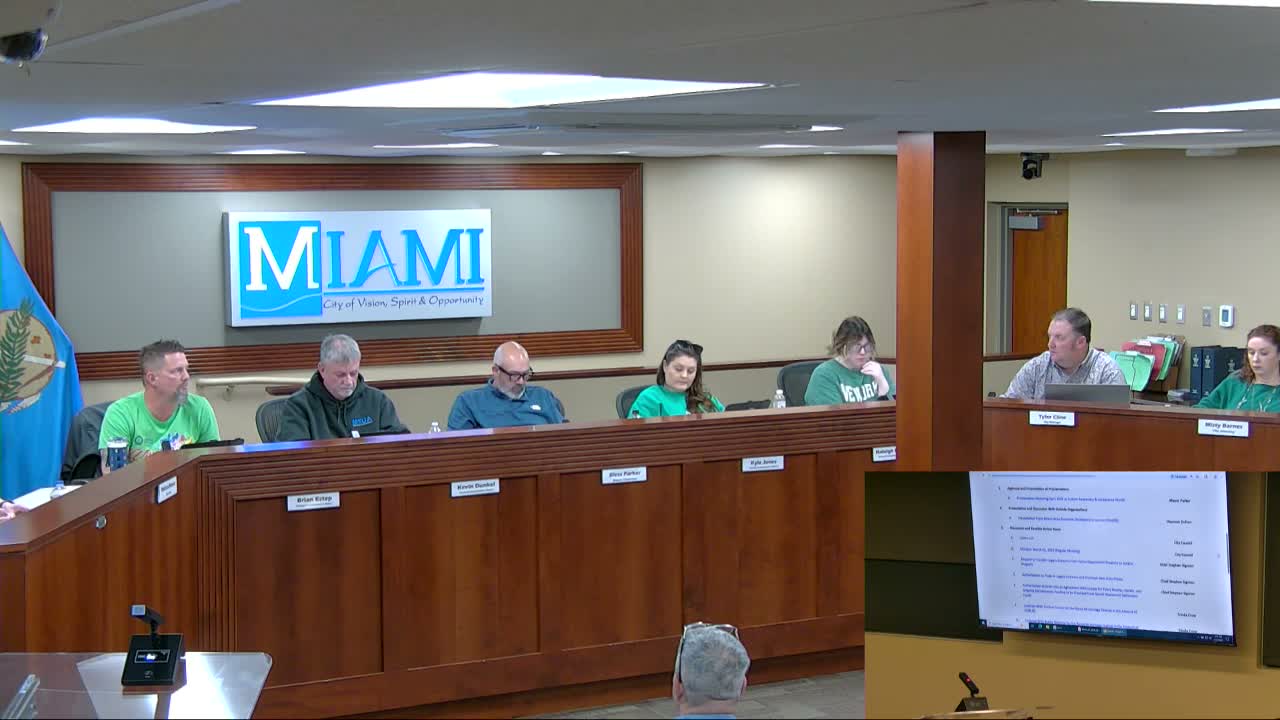
At the March 17 Miami City Council meeting Shannon of Miami Area Economic Development Services reviewed a three-year Retail Strategies contract, presented Placer AI foot-traffic data (including a figure of 'over 900,000 visits a year' for the Miami Walmart), and said outreach from a February ICSC show generated site requests from retailers and developers.
Shannon, representing Miami Area Economic Development Services, told the City Council on March 17 that the city’s three‑year engagement with Retail Strategies is progressing and is already generating promising retailer and developer interest.
“We entered into a 3 year contract with Retail Strategies to help us with retail development,” Shannon said, describing Year 1 as immersion and market discovery, Year 2 as ramped outreach and relationship-building, and Year 3 as the phase when site-level results typically appear.
He presented consumer and foot-traffic metrics drawn from a tool called Placer AI to illustrate Miami’s market strengths. Shannon said Miami’s Walmart records “over 900,000 visits a year,” and that the local Sonic has “over 1,000,000 visits a year.” He also cited median-household-income estimates for Ottawa County (roughly $48,000–$52,000) and noted the city’s trade-area market supports roughly $160 million in annual retail sales.
Shannon outlined the team’s gap analysis—categories where local residents currently spend outside Miami—and identified priority targets such as restaurants and building-material/garden-supply stores. He said Retail Strategies uses peer analysis to compare Miami to similarly sized communities and to identify opportunities such as the presence or absence of big-box anchors.
He mapped three primary retail corridors (North Main, Downtown and the Eastern corridor near the Turnpike) and summarized a corridor-level SWOT analysis. Strengths include anchor retailers and regional highways (US‑69 and I‑44); weaknesses include limited corridor connectivity; opportunities include underdeveloped sites near interchanges and interest in ground-lease structures; threats include competition from nearby Joplin and rising construction costs.
Shannon said the team withheld specific site-target slides from the public presentation to avoid affecting negotiations and site pricing. He reported that a February ICSC Red River trade show trip produced meetings with national prospects and developers; attendees returned with specific lead requests for acreage, pricing and building availability. “These retailers are now reaching back out to us and asking for very specific site location information,” he said.
Council members asked clarifying questions and complimented the team’s outreach. The presentation ended with Shannon saying the city is already seeing responses and does not expect to wait the full three years for some measurable outcomes.
Next steps: staff and Retail Strategies will continue targeted outreach, collect site-level information for interested retailers, and report back to council on major commitments or formal incentives that might be necessary to secure deals.