Get Full Government Meeting Transcripts, Videos, & Alerts Forever!
Get email alerts on the Medical Marijuana topic
No spam. Unsubscribe anytime.
Miami council considers ordinance to regulate medical marijuana businesses, sets proposed fees
Summary
The Miami City Council reviewed Ordinance 2026-08 to create city licensing, safety and fee requirements for medical marijuana businesses. Staff said an outside study recommended $1,500 but city rules permit only recouping actual costs, with staff indicating roughly $750 could be justified.
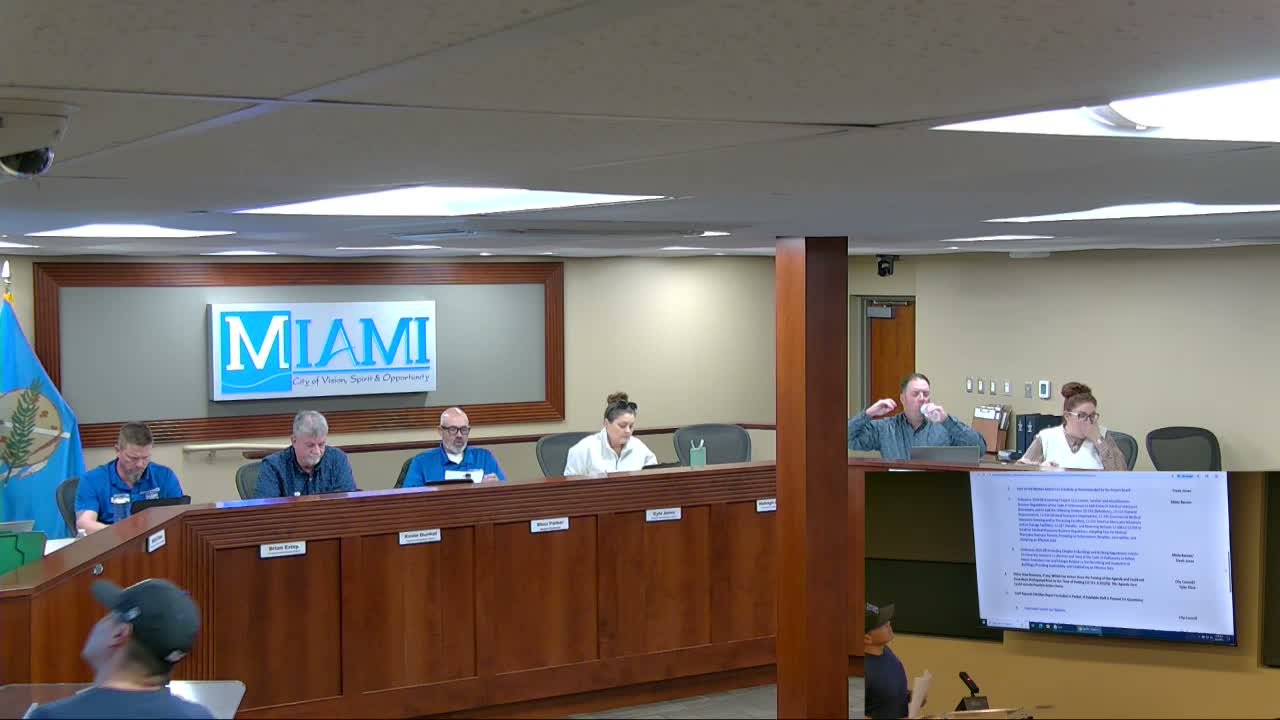
Miami — City staff presented Ordinance 2026-08 on March 3, which would add a new article to chapter 12 of the city code to regulate medical marijuana businesses, including dispensaries, commercial growing and processing facilities, and wholesale/storage operations. The ordinance would establish definitions, general requirements, permitting, enforcement and penalties and would authorize the city to charge fees for inspections and licenses.
A staff speaker summarized a Willdan study that recommended a $1,500 licensing fee but said state statutes and administrative rules permit the city only to recover its actual expenses. "We could only justify about 750 in good faith," the staff member said, explaining that the city cannot use the fees as a revenue stream and must limit charges to documented costs.
Council members asked whether sales tax or other municipal taxes apply specifically to medical marijuana transactions; staff said that point would be checked and clarified separately. Staff also said licenses would be required and renewals occur annually; the council was told that businesses renewing after the ordinance takes effect would fall under the new licensing regime rather than being grandfathered in automatically.
Council discussion focused on ensuring fees reflect inspection and regulatory costs. A staff speaker described the inspections as multi-departmental, often involving fire personnel and code officials, and said inspection time can vary by facility depending on deficiencies. The staff speaker noted that some sites have required substantial corrective work under newer state regulations.
A motion to approve the ordinance was made and seconded during the meeting; the transcript records the motion and subsequent procedural progression. The ordinance text as read would adopt fees, enforcement and penalties, and declare an effective date; the effective date was not specified on the record.
Next steps: The council moved the ordinance forward at the March 3 meeting. The transcript does not record the effective-on date or a detailed vote tally in the audio record excerpt provided. Further administrative clarifications (sales-tax applicability, final fee schedule and implementation details) were identified as items staff will confirm.