Get Full Government Meeting Transcripts, Videos, & Alerts Forever!
Get email alerts on the Line5 Alternatives Remand topic
No spam. Unsubscribe anytime.
Tribal intervenors tell court MPSC alternatives analysis for Line 5 tunnel was narrowed; ask for remand to develop MEPA record
Summary
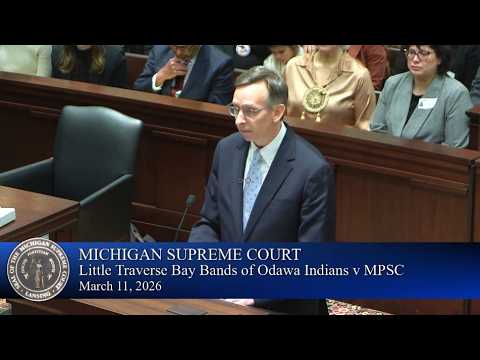
Counsel for tribal intervenors told the court the MPSC confined its MEPA review to the tunnel footprint and excluded broader likely effects, citing pipeline age, prior spills, and the 99-year lease; they asked the court to reverse or remand so evidence can be developed. Enbridge countered that the tunnel reduces risk and that remand would cause long delay.
Counsel for tribal intervenors told the Supreme Court that the Michigan Public Service Commission’s environmental review of the proposed Line 5 tunnel improperly limited consideration of the project’s likely effects and produced a one-sided alternatives analysis.
Adam Murchensky, arguing on behalf of the Bay Mills Indian community, the Grand Traverse Band of Ottawa and Chippewa Indians, the Little Traverse Bay Band of Odawa Indians, and the Natawasepe Huron Band of Potawatomi, said the proposed replacement threatens natural, cultural and economic resources and that the commission’s rulings excluded categories of effects that should be considered under MEPA. He urged reversal or remand, saying the record lacks the MEPA-specific evidence necessary to determine whether the project will likely pollute, impair, or destroy resources beyond the immediate construction footprint.
Murchensky told the court the replacement segment is unusually old, crosses the Straits of Mackinac, and is legally contested (including an attorney general suit and questions about the easement). He said experts could show that the segment has exceeded its design life, that the replacement project carries engineering challenges (counsel cited a construction horizon of about 2032), and that the existing line has a spill history (the transcript records a figure of 36 spills totaling about 1,100,000 gallons, as stated by counsel).
Enbridge counsel John Bersh responded that the MPSC’s factual finding of impairment is sound and that the correct baseline for alternatives is the operating pipeline in the Straits; under that comparison, moving the pipeline into a protective tunnel is more protective than continuing operations on the lakebed. Bersh warned that remanding for thousands of additional pages of evidence and further appeals could delay the project by five to six years and keep the pipeline operating in place while risk continues.
Justices probed whether broadening MEPA review would deter utilities from seeking safety upgrades in the future and asked how to draw a principled line between maintenance and replacement. Intervenors and appellants said this replacement is not ordinary maintenance and that MEPA allows development of record evidence to determine likely effects. The court concluded argument and submitted the case for decision.