Get Full Government Meeting Transcripts, Videos, & Alerts Forever!
Get email alerts on the Mepa Judicial Review topic
No spam. Unsubscribe anytime.
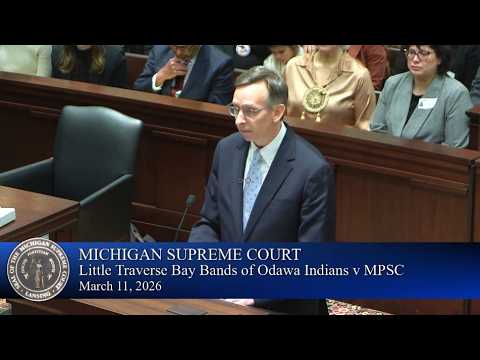
Justices debate whether Michigan courts must independently review MPSC MEPA findings in Line 5 tunnel case
Summary
At oral argument in Traverse Bay Band of Odawa Indians v. MPSC, advocates clashed over whether Michigan law requires courts to make independent judgments under the Michigan Environmental Protection Act (MEPA) or may defer to the Michigan Public Service Commission’s environmental determinations; intervenors urged remand to develop missing evidence about likely effects and alternatives.
The Supreme Court heard competing views over how strictly Michigan courts must review administrative environmental decisions under the Michigan Environmental Protection Act during arguments in Traverse Bay Band of Odawa Indians v. MPSC.
Appellants’ counsel David Scott, representing the Environmental Law & Policy Center and the Michigan Climate Action Network, told the justices that WEMIAC and MEPA’s text require courts to exercise independent judgment rather than defer to agency conclusions. Scott said judicial review under both section 17(4) and 17(5) of MEPA requires courts to determine whether proposed conduct is likely to pollute, impair, or destroy natural resources, and that the Court of Appeals erred by accepting the commission’s NEPA analysis instead of conducting de novo review.
Scott acknowledged gaps in the administrative record on MEPA issues and told the court the appropriate remedy would be to remand to the Michigan Public Service Commission (MPSC) so the commission can develop the missing evidence; he reserved four minutes for rebuttal.
The bench pressed how such remands would work in practice. Justice Welch asked whether remand for additional evidence would simply delay finality and whether a later de novo appellate review would follow. Scott and later intervenor counsel said remand was the right path when the record is incomplete for the court to apply MEPA’s legal standards.
Intervening tribal counsel and appellants also criticized the MPSC’s alternatives analysis as “lopsided,” saying the agency confined its review to harms within the immediate construction footprint and excluded longer-term or systemwide effects. Counsel argued the statute’s phrase “has or is likely to have such an effect” requires case-specific factual inquiry into whether the project will likely pollute, impair, or destroy resources beyond the footprint.
Enbridge’s lead counsel, John Bersh, urged the court to uphold traditional standards of review and to defer to the PSC’s factual findings. Bersh said the PSC and the Court of Appeals found impairment and that the dispositive legal question is whether feasible and prudent alternatives exist. He argued the status quo—an operating Line 5 across the Straits of Mackinac—must be the baseline and that moving the pipeline into a protective tunnel is more protective of the environment than the current arrangement.
Bench questioning probed whether different MEPA standards should apply to impairment determinations versus alternatives analyses and whether broadening the scope of review would turn routine repairs into wholesale reauthorizations of infrastructure. Counsel for the tribal intervenors and appellants emphasized that the present replacement project at the Straits is distinct from ordinary maintenance and said the record currently lacks the MEPA-specific evidence needed to resolve those questions.
The argument closed after extended exchanges about statutory routes for MEPA claims, the scope of administrative records, and the weight courts may place on agency factfinding. The court announced it would take the case under submission.