Get Full Government Meeting Transcripts, Videos, & Alerts Forever!
Get email alerts on the Wetland Buffer Variance topic
No spam. Unsubscribe anytime.
Commission recommends wetland buffer variance for Church of Pentecost with invasive‑species remediation condition
Summary
The Maplewood Environmental and Natural Resources Commission recommended approval of a variance to allow construction within a required 75‑foot wetland buffer for the Church of Pentecost at 1701 Jarvis Avenue, conditioning the endorsement on removal of invasive species and seeding to restore adjacent uplands.
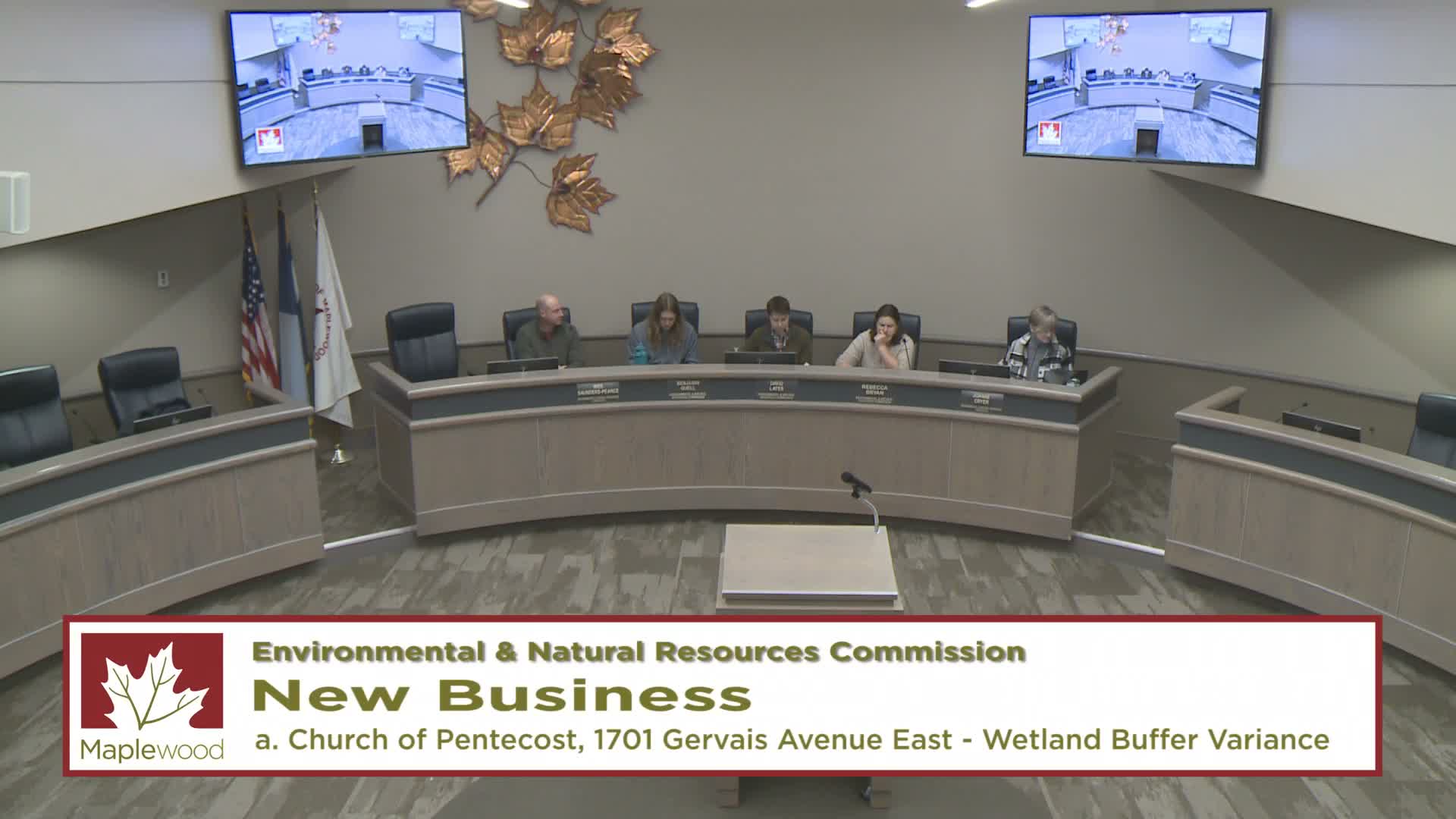
The Maplewood Environmental and Natural Resources Commission recommended approval of a wetland buffer variance for the Church of Pentecost at 1701 Jarvis Avenue after hearing staff and applicant presentations and lively commissioner discussion.
Staff said the site’s wetland was delineated and downgraded by the Ramsey Washington Metro Watershed District from a Manage A to a Manage B wetland, which under city code requires a 75‑foot buffer. The applicant proposes a 3,668‑square‑foot addition, bringing total occupancy to roughly 270 people and increasing the parking requirement to 68 stalls; the plan adds 30 stalls and places an infiltration basin and grading that would encroach into the buffer.
Staff flagged tree impacts: a survey counted 52 ‘significant’ trees and the proposal would remove 32, including several large oaks. Staff said the city code requires additional replacement totaling about 151.5 caliper inches; where on‑site planting cannot meet that requirement the ordinance allows payment into the city tree fund at $60 per caliper inch, which staff calculated as $9,090 for this application.
Applicants and consultants described mitigation measures including native seed mixes (a MnDOT‑style mix), targeted live plugs in erosion‑prone areas, invasive‑species removal in the buffer and adjacent uplands, and wetland buffer signage to prevent future disturbance. Robert Binder, the landscape architect on the project, described plantings and the tradeoffs they balanced when siting infiltration basins: “We use a basic, native seed mix… and we were asked to look at putting some plugs in,” he said.
Commissioners focused debate on whether to expand the formal buffer (a permanent encumbrance on the property) or require broader invasive‑species removal and native restoration on uplands outside the buffer. Commissioner Sanders Pierce moved to recommend approval of the variance with a condition requiring removal of upland invasive species (notably buckthorn) and seeding with a suitable upland native mix, and to require restoration where earthwork occurs within the buffer. The Chair seconded the motion. The commission voted in favor; the motion passed and staff said the matter will go before City Council on November 24.
Joseph O’Paugh, identifying himself as a church leader, said the congregation sought a practical balance between ecological mitigation and cost: “We want to be judicious with kind of the money that hard‑working people bring to the church,” he said, and expressed willingness to pursue plantings that are feasible for the congregation.
The commission’s recommendation includes conditions to secure a three‑year buffer establishment and maintenance plan, escrow for planting and maintenance, and requirements for long‑term tree and landscape management in public right‑of‑way areas tied to the project. The commission did not adopt a requirement for underground stormwater management as primary mitigation, with several members saying invasive‑species removal and expanded upland restoration would deliver greater ecological value for the cost.
The commission’s recommendation will be forwarded to the City Council, which is scheduled to consider the land‑use permits on November 24.